Sunday, April 26, 2009
The End of New Labour
For once in my life, I wish I could see the future.
Watching Izzy opening her eyes this morning at the start of her 17th week of breathing, first smiling and then giggling as she focuses on my face (the source of her amusement may possibly be down to the absurd way my hair stands on end after a night on the pillow – her Dad currently bears a remarkable resemblance to Ken Dodd), I asked myself what sort of world she faces. Yesterday her grandmother, now a sprightly 88, told me she was extremely worried about the baby’s future; 11 years ago, when my last child was born, she had no such qualms. In those days the world was somehow so certain; now, nothing looks safe.
The other day some students asked me what would be the best part of the television industry for them to join when they leave university. I replied honestly that I hadn’t the slightest clue; already my industry resembles nothing I’m familiar with. The perfect storm of digital television, the internet and the recession has wiped the slate clean; what happens next is anyone’s guess.
So it is with politics. This week New Labour was finally buried by Alistair Darling. In fact, as a political construct, New Labour physically died some while ago, killed not by Brown or Blair or any individual human act, but by the demise of the very circumstances which brought it into life: the opportunities for low taxation and raised public expenditure offered by a strong, growing economy. The recession has washed away the soil in which the New Labour harvest was happily growing and which allowed it to survive scandal and sleaze through three consecutive seasons.
In politics the death of one ideology normally coincides with the rise of another. Not this time. The funeral of New Labour coincided with the cremation of the Tories’ own response to it. Cameron’s policies were based on the very same assumptions as Labour’s and so they too have gone up in smoke. Continuous growth was assured, boom and bust was over; the only argument between the parties was how to divide the spoils. Now politicians, economists, bankers and the electorate are gazing at the same blank sheet of paper. Where do we go from here?
Labour is probably back where it started, in the unelectable doldrums. You can already see the Tory posters for the next election: Labour is the party of higher taxes. But what is the alternative? Whichever government comes into power will be forced to make such savage spending cuts, such difficult decisions about taxation, the world in which Izzy learns to read and write, cut her teeth and sing her first song will be so different from her brother’s that I can’t begin to imagine it.
So how worried should I be about this new world? Well, in one sense I like the blank sheet. Anything is possible if we grasp the future and I do believe the door has opened for a new kind of politics and a new conviction. America already has Obama: this Wednesday sees the end of his first 100 days in power and I swear the air wafting across the Atlantic is now smelling sweeter. In the UK, we too need our messiah, and I doubt very much that someone as out of touch with the real world as David Cameron is going to fill those shoes.
I certainly hope, for Izzy’s sake, that we find that leader. I also hope my innocent wide-eyed daughter doesn’t grow up to see the tired old order, in which the politicians’ policies are based not on conviction but on whatever they think is needed to win over the voters. Or am I, like Ken Dodd, looking at things just a little too optimistically?


Monday, April 20, 2009
I Dreamed A Dream

By this morning the video of Susan Boyle singing I Dreamed A Dream will have been viewed over 40 million times.
You’ve got to hand it to the Britain’s Got Talent team: this was great television, edited like a romantic film, with quirky “comedy” music as she ate her sandwiches and confessed she’d never been kissed and then a huge instrumental climax from the real Les Miserables for her standing ovation. But even without the manipulative editing it was still genuinely touching.
Susan’s voice is nothing special: there are thousands of amateur singers out there with similar renditions of that tired old standard. What Susan Boyle was all about was little to do with talent and everything to do with the audience itself. Close your eyes and think of a beautiful 25 year old and you’ll notice wavering and strained notes. Open them again and see Susan Boyle’s innocent, overweight squashed face and terrible gold lace dress, and the contrast overwhelms your judgment.
This isn’t about her; it’s about us. It’s about the ironic wolf whistles as she comes on stage, and Cowell’s rude eye-rolling when she says she’s 47, and the embarrassed giggling as she rolls her hips and says she wants to be Elaine Paige: Yeah, right, we all say, and wait for her to be shot down. Then she sings, and it’s a wonderful moment, a Paul Potts moment, when the fat man sings and wins. It’s moving because, as Amanda Holden said, “everybody was against you”. The audience had already damned Susan for being ugly and overweight and for presumptuously coming onto its stage. But wow, the circus freak can actually sing, so we’ll layer the soundtrack, cut to a standing ovation, and make the viewers cry. Pure Hollywood schmaltz, and it worked.
The problem is, what should the producers do next? Allow her to carry on wearing those ghastly dresses and no makeup for the rest of the series? Or do they engineer a “swan” moment, and reveal her, eyebrows plucked, straight from the plastic surgeon? If they do, presumably the joke won’t work anymore, so will her voice then be any more special than the others? I guess they’ll keep her as she is until the Final. But won’t that be just as cynical and manipulative?
I encountered a similar problem with my own Susan Boyle moment. A few years ago, I produced a series called Star for a Night. On the first audition day my researchers came rushing in: I had to hear this girl. Hannah Morris was about fifteen, with buckteeth and glasses, nervously clutching the sheet music of My Heart Will Go On from 'Titanic'. She was so tiny; I looked at her in disbelief. Her voice brought the house down and she won the show. But when we came to the final “Best of...” programme at the end of the final series, Hannah had got herself contact lenses and a proper hairstyle. She had a recording contract and was no longer the geeky schoolgirl. Trouble was, she was now nothing special at all.
Sometimes preconceptions work in reverse. We were auditioning in Bristol when, amongst the I Dreamed a Dream wannabes (God, how we grew to hate that track) was a sweet little 14-year-old from Devon with cascading blonde curls.
“I’d like to sing You Make me Feel like a Natural Woman by Aretha Franklin”, she whispered. Our jaws dropped open. If ever there were a mismatch it was this pretty child and that adult song. Then the music started and out came the deep voice of a blues singer. We all cried. The girl was called Joss Stoker, a name she later changed to Joss Stone.

I wish Susan Boyle the best of luck for her future, but exactly whom the producers decide she should turn into for that future, now that’s a huge dilemma.
Sunday, April 12, 2009
Generation Gap
“The crying’s not right yet”, warns Hayley, as she presses “Play”. On the video screen, a young girl is sitting hunched up in the corner of a room. The shadow of a man appears through the window. The girl shakes and starts to cry. It’s an animation; not terribly sophisticated, but it works, and the work is all Hayley’s.
I’m in a classroom in an inner-city college where a group of students are showing me their course projects. This is a group of “unteachables”: kids of around 16 who’ve virtually dropped out of conventional education, the product of urban decay, family upheaval, in some cases addiction and abuse. Many are still illiterate and innumerate. The GCSE system has passed them by, but I’m astonished by what they’ve achieved. In just a few weeks they’ve learnt how to make proper “Flash” animations, with music, sound effects and neat little title sequences with their names proudly emblazoned on the front; they’ve planned, storyboarded, designed, filmed and edited – techniques which in the professional world would take scores of trained experts.
The results are pretty dark. One boy shows me a gang of skeletons catching and mugging a little old lady. The film is half finished. “So, does the old lady win in the end, then?”, I ask naively, expecting her to turn into Supergran. “No, she dies”, comes the response. “Perhaps she could turn into a skeleton as well and then get her own back?” I suggest. “No, she just dies”. Not exactly a Hollywood ending. There’s no artifice with these children; a psychologist would have a field day. Unequipped with the filters that sophisticated artists employ to process their feelings, these trampled lives come straight through the screen. Using the power of film to look straight into the soul.
Over the past few months I’ve been travelling round the North’s universities and colleges looking at how we teach our media students. What’s really amazes me is not how good these kids are, but how little I’ve been taught myself. When I joined the television industry, you needed a degree at a top university before you could be considered for a training course. Producers were the ideas people and, although some of us were directors as well, we relied on other people trained in craft skills to operate our cameras, edit our films, produce our animations and so on. Nowadays we’re in the world of what we call “user generated content” (or, YouTube). Our teenagers do the work of whole movie studios and put them straight on the web. Most of us over the age of 30 are left completely in the dark.
Back at Teesside University, where occasionally I appear under the grand title of Visiting Professor of Media, I recount this story to one of my colleagues. How can I have spent a lifetime getting to the top of my profession and not learnt any of the basic media techniques that a group of deprived 16 year olds have perfected? We’ll teach you, he says. Immediately I snap up the offer and list the skills I never learned that are now standard issue to all media students: editing, graphic design, website building, computer game design and, of course, Flash animation. He sets about organising some training for me and any other dinosaurs I care to invite.
Last Friday in Newcastle I had lunch with some of the North East’s top television producers. When I told them about my proposed re-education plan everyone round the table jumped at the chance. The fightback has begun; old grey dogs are learning new tricks; keeping up with the children is our new watchword. Next we’ll be learning how to use the remote control on our televisions. On second thoughts, that might be a step too far.
Monday, April 6, 2009
Saving The Children
[Madonna's application to adopt a second child from Malawi has been turned down]
It was the rocking that disturbed us most. Until she was almost a teenager Anya rocked herself to sleep, just as she had always done in the orphanage. Anya was one of 150,000 victims of the Ceausescu regime. The Romanian dictator tried to spread communism by artificially increasing the population. He banned abortion and the use of contraceptives and gave financial incentives to anyone with more than four children. The compliant but impoverished population could not cope and dispatched their extra offspring to state-built orphanages. There the children received little education and no love; the healthy were prepared for Ceausescu’s special police; the remainder were left to rot.
These weren’t orphanages at all: most of the children had parents or close relatives who simply couldn’t provide for their huge families. When the dictator was overthrown in 1989, it left the country with a huge problem.
In 1990 I took our programme Challenge Anneka to Romania. I will never forget the sights and sounds of the “orphanage” we chose to help. Or the smell. An intense stench of faeces, urine and decay, which overpowered you at the door. Three stories high, with a dank rat-infested basement, this was home to 650 of Ceausescu’s children. About a dozen staff tried to care for them without resources or training. There were no toys, playrooms, lights or heating, no working toilets and just one shower room with cold water. The kitchen reeked of rotting food and damp.
Each room contained twenty tiny rusting cots, and in each cot lay two children. Some were just skeletal babies, lying in urine-soaked filthy grey bedding; others were much older. Most of the children were too weak to cry; the older ones just sat and rocked. Rats ran around freely. In ten days we transformed its facilities, but the children remained.
Anya’s orphanage wasn’t as bad as the one we converted for the programme. It had toilets and heating. There was a swing in the yard outside. But there was no disguising the rocking. All the children did it.
Our motive for adopting wasn’t altruistic. My wife had discovered we couldn’t have more children, but we still wanted a larger family. Too old to adopt in the UK, we tried Columbia, but found we didn’t qualify. Romania matched our desire for a child with a child’s desperate need for love.
Madonna will almost certainly win her appeal to adopt baby “Mercy” later this week. She probably has the necessary resources and influence to sway the appeals procedure. However I admire Malawi’s concern for protocol. For in Romania, as a result of our television programme and others about the situation, the floodgates opened and thousands of British and American families tried to adopt, not because they genuinely wanted more children, but because of sympathy for the children they’d seen on television. As a result greed and corruption created a commercial international adoption industry, and that is one reason why Malawi is keen to set hurdles even for someone as altruistic as Madonna.
Adoption is the last, not best solution; communities should be helped to look after and integrate their own. But in our case, in a country riddled with debt and corruption, it was the only way forward for Anya and for us. It was difficult: four years without education, comfort or hugs took their toll on her, emotionally and intellectually. But eventually she grew into a beautiful and confident young woman. She is now 21, and last week started her first paid job.
“Mercy” is lucky – she is young, and, assuming she finds a home quickly, the effects of the institution will be short-lived. It’s a shame her experience of family life will be through nannies and an itinerant lifestyle. The poor child really needs a family, not a rock entourage. But almost anything is better than life in an orphanage.
Monday, March 30, 2009
Protest Marches
 I do like a good demonstration. It’s fun to walk down the middle of a road with a banner and a few thousand companions, chanting at empty buildings.
The French are very good at protesting. Just about anything gets them marching: too many British sheep, the cost of diesel, the state of the national airline – there’s scarcely a month goes by without a good Gallic riot. And once the police have squirted a few hoses, the Government usually does whatever the protesters were demanding.
By contrast, the G20 demonstration in London at the weekend was so very British. All brass bands and middle class organic farmers with a nice vegetable lasagna waiting for them in the Aga back home. They marched with their children carrying banners handmade on the wicker table in the conservatory. “What do we want?”. “Jobs! No More Poverty! The End of Climate Change! And, er, Save the Penguins!” “When Do We Want It?” “Now!” It was more street party than political rally.
A few weeks ago I went back to my alma mater York University with Greg Dyke, who’s now the university’s Chancellor. We were reminiscing about our own student protest back in 1972. Those were the days: a decent march over a single issue (the Bloody Sunday massacre), a few arrests, then a sit-in in the Vice-Chancellor’s office – which we were now sitting in with a glass of rather good white wine. We regretted missing out on 1968, when Europe really knew how to demonstrate. I suspect that by Wednesday a few thousand European anarchists will have flown into London to show us Brits how to spice things up.
Meanwhile I’m pleased to report my own little protest is gaining momentum. A fortnight ago I wrote about the lack of network television production in the region. Then last Friday Peter Salmon, the new Director of BBC North, popped up to Newcastle to announce that Tracy Beaker is coming here: 13 episodes of the children’s series will be made on the Tyne.
It’s a really good start, and, having met Peter, I’m convinced he wants to help us. However one series is just a drop in the ocean, just as 3 months every 7 years is scarcely victory for the campaign to bring the Lindisfarne Gospels to their rightful home. We should be marching down the A1 Western Bypass over that one. In fact, for maximum impact, we could combine it with our A1 dualising campaign. “What do we want?” “The Lindisfarne Gospels!” “When do we want them?” “As soon as we’ve built the visitor complex and got a decent road up to Holy Island!”
There are quite a few things in Newcastle I’d get out on the streets for. The streets themselves, for instance. I could imagine putting a brick through the window of the man who invented those absurd “No-Car” lanes. Unnecessary, ineffective and downright dangerous, they force you to weave in and out of the taxis, keeping your eyes on the instructions in the tarmac, ignoring stray pedestrians and other vehicles in the process. If Newcastle actually has a traffic planner, I can imagine him sitting in his office with a map and a pin thinking, What can I slow down this week? Sitting in his in-tray is a request for a road sign at one of our busiest junctions, between the A1 and the A696 road to the airport. He’s left the request sitting there for over two years now, presumably because he doesn’t want to spoil the fun of watching all those tourists going round in circles looking for the way out of the roundabout.
So, What do we want? “The Lindisfarne Gospels, More Regional Television, a New Road Sign, the End of No-Car Lanes, and No More Global Warning! Please.”
Sunday, March 22, 2009
Ski Stories
Every year around 40 people die from skiing accidents. The argument about whether or not helmets should be compulsory is largely irrelevant. At the speeds most recreational skiers zoom around, even a helmet can’t guarantee protection. Skiing is dangerous, and, to me, the most uncomfortable of sports. The news of Natasha Richardson’s tragic death has opened up wounds of personal grief, because I too lost someone very close, and I’ve always felt slightly responsible.
My best friend, best man at my first wedding and godfather to my son, was BBC Newsnight reporter Ian Smith. Tall, handsome, intelligent and incredibly athletic, Ian would turn heads wherever he went. He played tennis to county level and when we knocked a ball about on Saturday mornings he would return my weedy serves with smashes so violent the ball had to be prised from the netting. Ian was completely obsessive about hobbies – he did nothing by halves. When he took up cooking, he wasn’t interested in everyday food: he attempted the most sophisticated recipes and we all had to endure his experimental gourmet evenings. Then, one day in the early 80’s, I persuaded him to go skiing. It transformed his life and eventually killed him.
I myself would never have ventured on a ski slope had it not been for a beautiful woman. At the age of 29 I fell head over heels for a girl who lived in Brussels. Like most people on the continent who can pop up an Alp for the weekend, she was a stylish skier. One day she rang to say she had met a diamond dealer who had offered her the use of his chalet in Verbier. Sensing her excitement and panicking that she might go off with the dealer, I feigned enthusiasm and said I’d love to join her. “I never knew you skied”, she said. “I think skiing’s amazing” I replied, disguising the fact that I had never worn a ski boot in my life. But I did have a cunning plan.
We agreed our date in Verbier then I flew down a few days early and checked into the local ski school. Watching tiny children bombing down the mountain I thought, what’s the big fuss? Such a mistake: I never could understand why you should put all your weight on the downhill ski when every human instinct tells you to just sit down and enjoy the view. Nevertheless I plugged away and, by the time the girlfriend arrived, I could just about manage a shaky snowplough. The first morning she suggested a notorious black run. As we got out of the cable car I fell headfirst into a snowdrift. Through tears of laughter she said it was touching that I’d made the effort. A year later we were married.
I dutifully allowed skiing to share our life and, after listening to us droning on about the delights of gluhwein and mountain views (though secretly I hated the fact that I was always too cold or too hot, and invariably soaked through), Ian was eventually persuaded to join us. He was instantly hooked. Although nearly 40, he took to the sport like a 5 year old.
He became obsessed by powder snow and heli-skiing, and eventually quit his job to spend more time in the mountains. However his body didn’t have the suppleness of his ambition and he often had to be collected from Gatwick with sprained or broken limbs.
One day they brought him home in an air ambulance. He’d slipped over the edge of a glacier and hit his head. Ian never spoke or smiled again. The man who’d been one of the most promising television journalists of his generation spent the last five years of his life in a vegetative state in a home for the incurables. I have never skied since.
Sunday, March 15, 2009
Life and Death in Local Radio
The other day I was the guest pundit on the breakfast show of a local BBC radio station. The format required me to pontificate about anything and everything, interjected by phone calls from listeners.
The morning’s hot topic was a suggestion from some planet-saving organisation that people shouldn’t have more than two children. As a producer I know that what any good programme needs is a bit of a spat so, as both the only guest and someone who’s just become the proud father of his fifth child, I surmised that it was down to me to supply it.
The trouble was, worn down by lack of sleep caused by said Child Number Five, my brain no longer functions in the morning. For some reason the only thoughts that came into my addled mind sounded staggeringly right wing: Britain’s native population is actually decreasing, it’s the immigrant population which is going through the roof, etc. I think I ended up well right of Norman Tebbit. It was slightly scary that most listeners who phoned in wholeheartedly supported me. The radio station seemed to enjoy it too: I’ve been asked back.
I’m pleased because I do love BBC local radio, and have done so ever since I was first sent to work at a similar far-flung outpost as a young trainee journalist. For a rookie full of misplaced superiority and confidence, the experience was a baptism of fire.
The news editor was a bull of a man whose every sentence was laced with swear words, although his authority was somewhat undermined by the fluffy slippers he wore in the newsroom. He was waging a personal war against a madman in the town who ran his own extreme right wing party and who would send us lengthy press releases furiously typed on a very old typewriter (there were little holes in the paper instead of the letter O). When we refused to read them out in our bulletins, he would throw bricks through the newsroom window.
Every Friday lunchtime the entire station would retreat to the local pub, where the journalists spent the afternoon betting their wages in games of high stakes poker. Being the youngest, poorest and therefore least drunk member of the team, I was sent back to write and read the 3pm bulletin. One day I pressed the wrong button and switched the whole station onto Radio Four. Nobody appeared to notice.
The highlight of my stint in local radio was our special extended coverage of the formal opening of a long-awaited road bypass. When I say “special”, it was actually just me in the back of the radio car, a converted estate car with blacked out windows. It looked like a hearse with an aerial on the roof. In fact, local legend claims that it was once used as a hearse. Apparently the sports editor was enjoying an extra-marital relationship with the radio station’s receptionist when one evening he suffered a heart attack and died in her bed. The distraught mistress rang the newsroom and the lads brought round the radio car to pick up the corpse and transport it to the station’s surgery so that they could keep the affair from the chap’s wife.
I tried not to think of this story as I set the radio car on a bridge overlooking the gleaming new bypass and waited for the mayor to arrive for the ceremony. Suddenly a thick fog enveloped the road; I couldn’t see an inch in front of me. So I did what any self-respecting producer would do: I made up the whole thing. I described in detail the police escort, the mayoral car, the cutting of a non-existent ribbon, the first drive along the smooth new tarmac. It was a commentary worthy of a state occasion. It wasn't until I got back to the radio station that I found out the ceremony had been cancelled because of the fog.
Thank goodness the BBC wouldn’t do that sort of thing today.
Sunday, March 8, 2009
East of the Pennines
 Last week’s announcement that ITV is to close its studios in Leeds was a body blow for the North’s television industry.
Not only will hundreds of jobs be thrown onto the scrapheap already created by cuts in regional news, it now means that all studio production of what used to be called the best television in the world will take place in London or Manchester (which may as well be in London, it takes so long to get there on what is paradoxically called the “TransPennine Express”). Put simply, if any of our local producers were lucky enough to invent the next X-Factor or Britain’s Got Talent, they would have to travel to London, Manchester or Glasgow to make it.
A couple of months ago I was talking to BBC Chairman Sir Michael Lyons about the state of our industry. He proudly pointed to the impending relocation of five BBC departments to Salford as an example of the corporation’s commitment to the North. He asked me if I thought it was a good thing. I replied that far from solving our problems, I feared that the stronger Manchester becomes, the more difficult life would be east of the Pennines. “Ah yes,” he said. “The East of the Pennines Problem. I agree it’s something we need to address.” Well, no time like the present.
From the day that Granada took over Yorkshire/Tyne-Tees, the death knell sounded for our region; it was inevitable that everything would consolidate in Manchester. Now the axe has fallen, the only way the North East’s producers will get a voice on our national television will be by commuting on National Express or British Airways – or joining the traffic jams on the M62.
But it’s just possible that some good may come out of last week’s dire news. For the death of Yorkshire Television affects such a huge region, we might just be able to harness the wrath of the white rose to our own end. Northern Film & Media’s campaign, launched in the Journal just two weeks ago, should now be expanded to a North-wide campaign for network television. We need an unholy alliance to wreak political havoc with the broadcasters’ plans.
It worked in Scotland. I was recently in London pitching a show to the BBC. The Controller appeared to like it. We started talking about budgets, which is always a fairly good sign. He then said, rather apologetically, “Is there any way you could shoot it in Scotland?” The BBC now has an obligation to the Scots to produce a proportion of all its programmes north of the Border, and the BBC has fallen short of its quota. Thinking we might find a warehouse just outside Berwick-upon-Tweed to stage the show, I agreed. Sadly that series isn’t going to happen. “We liked it, but felt it was too innovative for a BBC1 audience,” came the rejection.
If the power of the Scottish lobby could lead to the BBC’s massive investment in studios and resources in Glasgow, couldn’t the same trick work East of the Pennines? Scotland only has 5 million residents; the North West, where all studio programmes outside London are now to be made, has only 6.7million. Yet Yorkshire, Lincolnshire and the North East have a combined population of 8.3million and not a single working television studio between them.
This could become a new cultural, political and economic battle and, harnessing the power of MPs from the Tweed to the Wash, we might just win it. Imagine if all British films were to be made in Hollywood – there’d be an outcry. So now’s the time to join the fight for local production. Write to your MP, write to Sir Michael Lyons at the BBC, put pressure on the Government and let the outcry begin.
Monday, March 2, 2009
Happy Beginning for an Old Dog
There’s nothing more satisfying than watching an old dog performing a new trick. As the cheers rang out with the bells of St Boniface’s Church on Saturday afternoon, Craster the border terrier, proudly sporting a new purple collar and lead, led his smiling owner down the aisle. The bride was radiant, young and beautiful, and next to her, with page-dog lead in one hand and wife held just as tightly in the other, was, of all people, Keith.
Those of us on the right hand side of the aisle could hardly believe what we were witnessing.
 At the overripe age of 55 Keith Hann, the grey-haired bachelor whom I first knew at school and now is a fellow newspaper columnist, had finally got himself hitched.
Poor Keith, holed up with Craster in his isolated cottage in the back of beyond – no, beyond even the beyond, almost in Scotland and ten miles from the nearest paper shop – for years well-meaning friends had made vain attempts to pair him off. There was no easier way to liven up a dinner party than to persuade Keith to recount stories of his failed love life. There were hysterical tales of blind dates with utterly inappropriate women, most of whom appeared to have turned into stalkers, nutters or lesbians the moment he met them. He’d been engaged several times, and it’s said that three expensive Tiffany engagement rings lay in his bottom drawer. Jo and I had resigned ourselves to having him on our Christmas Day waifs and strays list forever.
Then, out of the blue, came Maral. I actually thought she was a man at first; or possibly an anagram. For me Maral spelled Alarm, as Keith excitedly showed me her email. Apparently his amusing blog had generated some single female fans in Chester and one of them, Claire I believe she was called, asked a friend called Maral to write to him on her behalf.
Or that’s what the email said. But it was so witty that I’m ashamed to say (ladies, I apologise) it sounded as though it was a jolly jape written by a male friend. Her style of writing reminded me of Keith’s own humour, so I said that if Maral existed, and was vaguely female, he should try asking her out, and ignore the unfortunate Claire. Keith eventually telephoned, then met Maral, and the rest is history; or, rather, the future, as it now includes a bump called Charlie who is due this July 4th.
It was an appropriately eccentric service on Saturday conducted by a quirky vicar who called
 himself Rick the Vic. The congregation sat bemused as, like a stuck record, Vic repeated three times the formal question about whether Maral would take Keith as her lawful wedded husband.
“Are you sure?”, he kept saying, while Keith’s friends were hissing “Get on with it, man”, lest the groom had a change of heart. Some had delayed buying their wedding presents in case he failed to show, and Maral told me she was quite expecting to have to tell the wedding car to drive round the block a few times if he got cold feet.
In fact, it transpired that Rick the Vic was following the Iranian custom of asking the bride three times if she wanted to proceed. For Maral is Iranian, or as one lady whispered to me in Church, “Did you know, she is a loose Muslim?” I think she meant lapsed.
If opposites attract, this couple must be fused together. Maral: young, attractive, sociable, Muslim; Keith: Thatcherite, curmudgeonly, the world’s grumpiest old man. Yet they found they possessed the most powerful aphrodisiac: a shared sense of humour. Keith said in his wedding speech that since he met Maral, he has never laughed so much in his life. It shows.
Monday, February 23, 2009
Television Is Dead...

On Saturday night at the Sage in Gateshead the North East’s media elite assembled for the annual Royal Television Society Awards. It wasn’t quite the Oscars, but it was still an impressive shindig, with nearly 600 guests, ranging from veteran producers and local celebrities, to hopeful media students. Every UK region holds its own television awards ceremony, but ours is by far the largest, an astonishing fact considering our producers make the least number of programmes.
Last week Northern Film & Media, our local screen agency, launched a campaign to save our local production industry. It's not a moment too soon. They showed us some pretty bleak statistics: Wales, with a population only slightly larger than ours, produces thousands of hours for the UK’s broadcasting networks, whereas we produce almost none. In this region we fork out £134 million a year in licence fees, but the BBC commissions not a single North East network programme. It’s a shameful state of affairs. This region has creative talent spilling out of every pore, but its television industry is invisible in the national marketplace.
Blame for this decline has been laid largely at the door of ITV; I’m not sure this is fair. I think I know how the rot set in. It was in 1992 when, as newly elected chair of the film and television producer’s body PACT, I decided to launch a campaign for regional production.
I guess it was mainly guilt. Having been brought up on Tyneside, and leaving to join the BBC at the age of 21, it didn’t occur to me to return to my roots to work in the region. Like so many northern professionals, ambition and family had settled me in London, but I wanted to do something for my colleagues back home, because I knew how hard it was for them to breach the walls of Television Centre to get their ideas commissioned. Here I was in London, with hundreds of hours of juicy programmes, and my regional colleagues were getting the scraps.
So almost the first thing I did as chairman was ring up John Birt, who had just become the BBC’s director-general. I’ll never forget the call, or the circumstances. I was in The Ivy (where else??), and he called me back after I'd left a message with his assistant. I'm only setting the context, because what he told me on the phone was so utterly shocking I can still picture myself reeling with disappointment against the wooden panelling. I told John that we wanted the BBC to do something to increase the commissions for producers from outside London. He replied, “It’s not the BBC’s job to protect regional production; that’s what ITV is for”. I probably ordered a very large glass of champagne to calm me down.
That simple sentence sounded the first death knell for regional producers. As if to underline his point, shortly afterwards he closed down all the thriving local BBC features departments, the source of wonderful local programmes over the years, and more importantly the training ground for budding producers, directors and cameramen who, by an unfortunate quirk of fate, found themselves born north of Watford. The features department used to have direct links to the networks; now all BBC regional programmes were to come through the news division. Basically, if it wasn't a factual documentary which fitted in with the news agenda, they weren't interested. No entertainment, no features, and certainly no drama or music programmes. It was the beginning of the end.
This response fired our regional campaign, which we won hands down: the BBC was forced to set aside 30% of all its production spend for non-London producers, and in 1998 this quota was extended to Channel Four. But despite having an obligation to commission, the BBC accepted no responsibility for maintaining the supply chain. It had already destroyed its regional infrastructure of training and support that was essential to nurture local producers into the network fold, and it didn't offer anything in exchange.
Leaving the job to ITV ultimately proved disastrous: for when Tyne Tees was bought by Yorkshire, and then both became part of Granada, it was inevitable that network production would be focused on the larger companies, rather than the remoter corners of the empire. As a network force, the home of The Tube, Highway, Supergran, and hundreds of hours of network production, including quality drama, the spirit of Tyne Tees withered away. They shut their big network studios on City Road and moved their
news operation into an office block in an industrial park.
From then on Tyne Tees could only offer our producers a meagre supply of local documentaries (produced on budgets less than 10% of network prices). A friend of mine has made 30 documentaries over the last few years for Tyne Tees at an average budget of just £12,000. Last year I made a single non-broadcast pilot for a network show which cost £600,000. And I doubt the series will ever be made. That's the chasm between us.
Local producers have worked wonders with these derisory resources, but recently the axe fell on even this small consolation. ITV is no longer commissioning local documentaries, so from now on they’re on their own.
So on Saturday night, as the final batch of regional programmes competed against each other and Wire in the Blood received its last ever nomination for Best Drama, there was anxious talk across the ham and pease pudding canapés about the future.
Yet, amazingly, it wasn’t all gloom; there was a real determination to fight on together. One well known actress from Emmerdale stood up on stage and issued a rallying cry for us to keep on going, even though by then she'd clearly had more than a couple of glasses of RTS champagne, she brought the house down. It was a theme echoed by all the award-winners throughout the evening.
Our producers now need the support of all our politicians and opinion formers. The creative industries will be the heart of what the government proudly calls Digital Britain; it’s vital that our region will be part of that future. Watch this space.
Monday, February 16, 2009
My Censored Newspaper Column
[My usual weekly column in Newcastle's daily newspaper The Journal didn't appear this morning. My editor gave me the following explanation:
"Tom, I've decided not to print your column tomorrow. Disparaging newspapers and those who write for them should not be the work of Journal writers, however contemplative they intend to be."
For my regular readers, here's what you missed.]
The problem with writing a newspaper column is the deadline. I’d love to be writing on Monday morning as you read this, so you can know my thoughts about things that are happening right now (your right now, not mine, because my right now will have happened several hours ago).
I mean, who knows what excitement could have occurred in the intervening hours while The Journal’s presses are churning away and the vans drive through the city to your newsagent. Another of our banks (yes, the banks we now own) could have accidentally lost us another £8 billion; a third plane could have nosedived into a city; Gordon Brown could have smiled (unlikely, I know, but hey, it’s been a surprising few weeks).
But I guess if you really wanted to know what I was doing or thinking right now, we’d be using Twitter. There, I’ve said it: the T-Word. I’ve absolutely no idea how or where you “twitter”, or why it’s called “twitter”, but everyone I speak to is talking about it, if not actually twittering, so I thought I’d mention it this week to be part of the club. Obama twits (or is it tweets?), and so do Ross and Fry. It’s a social networking thing where the only communication you have with your friends is telling them what you are doing or thinking. In 140 characters or less. On your mobile phone. Goodness, modern life is exciting. How did we live before Twitter?
So, What Am I Doing Now?
"I’m actually writing these thoughts in the contented afterglow of Valentine’s Day."
That was only 81 characters, so I’ll add: "With 3 of my 5 children, including baby Izzy, and partner Jo."
Somehow the space restriction doesn’t encourage a satisfactory reflection of my feelings of bliss engendered by watching the family playing together, separated by three marriages and 27 years; or my continuing amazement at Joanna’s beauty as she smiles at baby Izzy snuffling at her breast. My world is now complete, the ultimate Valentine’s present. It’s enough to stimulate the green shoots in a recession.
Speaking of which, I know something good is on the way the way because of the tweets. Not the messages sent on Twitter (which really are called tweets), but the birds in our wood, which have gone quite twittery over the last two days. They know it’s soon to be the end of this cold, heartless winter. And according to the man in the country store, loud tweeting means early Spring.
I’m surprised I’m feeling so positive. On Thursday night I was at a dinner party with the leaders of quite a few media organisations, and, gloves off, we all said what we really felt about the recession. Gloom doesn’t describe the collective feeling. The consensus was that we’ve seen nothing yet and it’s going to get a great deal worse. It’s enough to make you go off and live in a farmhouse in faraway Northumberland. Which, as luck would have it, I do.
But the assembled gathering also felt that, aside from utter cowardice of our bankers, what’s really holding back those green shoots is public confidence. We’ve all got our heads under the duvet, waiting for winter to end, and until we pop them out and tweet like my birds, it never will. It was also felt that the last people to spot the upturn will be the journalists, and especially the newspaper columnists. News likes gloomy; good news doesn’t sell papers.
So as soon as I’ve worked out how to do it, I’m going to get Twitter. Because I want to know what real people are doing and thinking right now – not the bankers and politicians and journalists. Because that’s the key to the end of this recession. And the moment there are some positive vibrations floating around I’ll let you know. Albeit a few hours later.
[As you will surmise, the reference to journalists was actually made by others at the dinner, attended by some senior broadcasters, publishers and journalists, together with a number of academics. Because it was a small private dinner held under Chatham House rules, I can't reveal who said what. These thoughts are also echoed to a certain extent in an article on Twitter in today's Media Guardian - where it's revealed that switched on journalists are now using Twitter to get information about popular culture and the mood of society.
In one way, I'm rather relieved this wasn't published, as the piece is far from my best work. I suspect that familial contentment doesn't make for spicy writing. However, I don't really see where the slight against journalists appears, other than my cheap and unnecessary cliche about good news not selling papers. I don't actually believe this axiom, particularly not in the case of The Journal, which provides an excellent service for the North East and specialises in front page splashes about major local achievements. It also holds celebratory campaigns for the good things about life in the North, like its food and many natural assets.
However my real point, albeit sloppily made, is about the social climate, and how we can spot changes in what people want and think if we keep or ears to the ground; it's a theme mentioned elsewhere in this blog, for I believe that one of the primary jobs of a television producer (and also a journalist) is to sense the popular zeitgeist in advance. After all, we're pitching shows which won't be seen for a year or two, and we want them to be enjoyed - so predicting public taste and fashion is part of the job. As a consequence searching for green shoots in these dark days is an important goal - we can't rely on the house price index or unemployment figures. These indicators reflect what has already happened. What's interesting is what is happening now - and that's where Twitter could come in handy.
Incidentally, one person at the dinner suggested that it should be the BBC's role to provide uplifting content for the nation in its hour of need, rather as the British film industry tried to do in the 30's. I pointed out that at least one country in Europe had an alternative solution to the depression, which was fascism. Perhaps more episodes of Strictly Come Dancing might have a positive effect. Or maybe Bruce Forsyth should become our Fuhrer.]
Monday, February 9, 2009
Selina Scott to the Rescue

Seeing the ruins of Lord Steven’s garden fence beneath my dented car on Monday night, I was reminded me of another fence I mangled some 25 years ago.
In 1984 I had a little red sports car, a Mazda RX7, which I used to drive at absurd speeds whenever I had the opportunity. At that time I was still working for the BBC, producing a BBC1 dance series called The Hot Shoe Show, with Wayne Sleep and Bonnie Langford. That series had brought me into contact with Andrew Lloyd Webber for the first time, and I’d just directed a video of his musical Song and Dance. The Hot Shoe Show was in its second season, and had an incredibly complex and exhausting schedule, but I still said yes when Andrew asked me if I’d moonlight to direct a video of Unexpected Song with his new wife Sarah Brightman. So it was that after a long day in the office in Shepherds Bush, I’d hit the M4 and drive over to Sydmonton, his Victorian pile on the edge of Watership Down in Berkshire to plan the shoot.
As I’ve never been one to knowingly arrive early for anything, I used to force my Mazda to ridiculous speeds in order to make up time once the road had emptied itself of rush hour traffic. Just after Reading there’s a stretch of motorway which runs without an exit for about 13 miles. It must be one of the most boring stretches of motorway in the country.
One evening I was cruising in the fast lane at well over a hundred miles an hour, and I was about ten minutes from the Newbury turning to Andrew’s house. I was finding it hard to keep my eyes open and had to turn the air vent onto my face to stop myself nodding off.
Then I felt a bump, and blinked hard. A pair of Wellington boots was flying in slow motion past my windscreen, followed by a kettle, some large lady’s underwear, and then, held weightless in suspension as if in a space capsule, a cloud of small household items. It turned out to be the contents of a small white caravan which I’d apparently shunted up the rear, and which had managed to absorb some of the impact of my car. Over what seemed like about thirty seconds (but in truth must have been a fraction of this time, for the adrenalin in a road accident causes everything apparently slow to a snails pace) I pushed caravan and its unfortunate owner off the road. The driver of the other car and his wife, quietly motoring to a week’s holiday in Devon, must have had no warning. One moment they were gently pootling in the middle lane, as caravan owners tend to, oblivious to everything else but the Archers on the radio, the next they were being pushed out of control towards the hard shoulder.
I’ve driven this stretch of road many times since, and I’m amazed at the narrow escape we all had. At the point where the accident happened there’s a steep ravine to the left of the road. Immediately afterwards there’s an equally steep embankment about a hundred feet high. In between the two runs a small ramp of grass and trees, like a sliproad no more than ten feet wide. One second earlier and we’d have been over the ravine, with a fall of into the river below; a second later and we’d have hit the hill and overturned. As luck would have it, with just a couple of feet on either side, my car pushed us all up this narrow ramp. Slowed down by some newly planted trees, we came to rest at the edge of a field. I can still picture the broken fence post in front of me, and the steam pouring from my bonnet.
I got out of the car, and went to check the others. Luckily noone was hurt, but the caravan had disintegrated and both cars were written off.
“What happened?”, said the confused driver, a man in his 50s who worked for the gas board. Avoiding the temptation to apologise and say I must have fallen asleep and driven into his mobile sitting room, I merely repeated, “What happened?”
Together we made our way down to the motorway. Traffic had come to a halt as people stopped to gape at the carnage. Except there was no carnage, just two cars and a few bits of tangled metal in a field.
“What happened?” The words spread round the onlookers. Someone found a bit of white caravan by the roadside with a blue scratch on the side. Then someone else said he had seen a blue van drive off after the accident. And then the police arrived.
They were terribly polite. They took our details, examined the debris and called for a tow truck to extricate our cars from the field. By now the “witnesses” had embellished the story. Apparently a blue van, going much too fast, had struck the caravan and knocked it into the side of my car, pushing both vehicles off the road. The policemen nodded, and wrote things into their notebooks. They radioed the details of the blue van. I kept quiet.
“And what do you do, sir?” one of them asked.
“I work in television”.
His notebook closed. He lowered his voice and said into my ear, “Do you by any chance know Selina Scott?” Selina was in those days the host of BBC Breakfast News and by far the most desirable female celebrity in Britain: to police officers, anyway.
“Actually, I do – we worked in the same department for a while”.
“Do you think you could get her autograph?”
“I’m sure there’s no problem, officer.”
We were standing beside a smashed motorway marker sign. Coincidentally, it appeared to be exactly the same colour as the blue scratch down the side of the bits of caravan. The same blue as the missing van. The policeman studied it carefully, and wrote something down in his book.
Just then the tow truck dragged my car out of the field. It came to rest beside us. There, embossed on my rubber front bumper, was the imprint of the number plate of the caravan. Clearly my car had struck it precisely in the rear.
The policeman frowned and turned to me again. “Of course, sir, if you hadn’t been hit by that blue van; if, dare I say it, you had fallen asleep at the wheel, and you’d driven into the back of that poor couple’s caravan, now that would be quite serious. It would in fact be called dangerous driving.”
I nodded sadly, as more bits of broken blue sign were extracted from the remains of the caravan.
“Could I have a private word, Sir?”
The policeman led me up the side of the motorway.
“The thing about dangerous driving is, that it’s incredibly difficult to prove. Usually, it’s just not worth our time. Now, are you absolutely sure that you can get Selina Scott’s autograph?”
Two months later I got a letter from Thames Valley police. It apologised for the fact that they had been unable to trace the third party in my unfortunate accident on the M4: despite exhaustive enquiries they were unable to find the blue van.
That was my first and last road accident. Until last Monday, that is. Tomorrow I take the Volvo into the “Mill Car Clinic” for an estimate. It’s been an expensive week.
[By the way, regular readers of this blog might like to know that you can "follow" its contents regularly by clicking on the Follow This Blog link on the right. Or you can "subscribe" by clicking on the appropriate link. Or post a comment - I'd appreciate your feedback.]
Sunday, February 8, 2009
How Not to Drive Down a Hill
I have no sympathy for those thousands of motorists caught in snowstorms over the last week. I mean, why on earth does anyone go for a drive in a blizzard, playing chicken with the emergency services? – they deserve a good dose of hypothermia. It’s no use blaming the councils for running out of grit, people should be at home watching Newsnight rather than selfishly obliging nice innocent villagers to unlock their community halls and heat up bowls of soup in the middle of the night.
There’s something about bad weather that brings out the worst in men. Yes, men, for I doubt many women would be stupid enough to venture out in conditions like these. But no, a man has to get out his 4x4 and show it off.
On Monday night, just as a white blanket was descending over our valley, I decided to visit my Mother. “Don’t come,” she warned, “you’ll never get down the hill”. “Don’t be absurd, Mum”, I laughed, “the Volvo has four wheel drive.” “You’ll still never get down the hill,” she droned. “I’ll be fine; I’ve got a special button called Hill Descent Control. You just press it and take your foot off the brake.” “Off the brake? You’re mad; you’ll end up in the river.” “Mum, the engine torque holds back the weight of the car”, I added, without the slightest clue of what I was saying.
The white road snaked into the darkness below. My Hill Descent Control button has a picture of a car confidently gliding down the side of an alpine peak. I pressed it and led the shiny new Volvo into the abyss. 10 jerky seconds later, I realised that this had all been a huge mistake. It must be a sensation felt across the nation this week, especially by those morons in Devon who thought they could make it safely up the A38 before the snow was up to their windscreens. It’s been a great week for bodyshop repair companies. Halfway down the hill, I knew there was no way my two ton monster would make the turn into Mum’s drive; the powdery white surface was the frosting on a cake of pure ice.
Mum was wrong about one thing, though: I didn’t end up in the river. This was thanks only to a huge gatepost connected to an even larger gate, along with about twenty feet of perfectly good fencing. All of which belonged to the former Metropolitan Police Commissioner, Lord Stevens, and which currently lie in pieces somewhere near his front porch. He was terribly nice about it. Lady Stevens took photographs as Britain’s most distinguished policeman and I tried to tug a ten-foot fence plank out of my chassis; it had somehow managed to drive itself into the fog light and out of the other side of the car, so the Volvo re
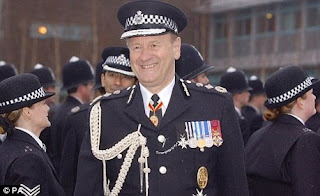 sembled a gazelle impaled by an Assegai spear.
He’s a decent bloke that John Stevens. Apart from blaming his road for being too icy, and his gate for being shut, neither of which were any justification for an event caused by my customary stubbornness and refusal to listen to my mother’s good advice, it was obvious there was no way my all-weather XC70 was going to get out of his front drive until the thaws came, so he gave me a lift home, and on the way demonstrated how a real expert drives on ice. I felt about 12 years old.
The last time I destroyed a fence was 30 years ago, on the M4. That time I was rescued by Selina Scott. To be precise, I escaped arrest by promising the boys of the Thames Valley police a signed photograph of their favourite newsreader. It’s a shameful story, which I couldn’t possibly repeat here. But if you really want the full confessional, see my next post.
Sunday, February 1, 2009
Immorality In Immingham

I went to Immingham on Friday. It’s not what you’d call a destination resort. You drive forever across a flat landscape. Then you see two dozen thin chimneys sticking up through the horizon, like cardboard models. You can smell them long before you arrive. It must be like living in a petrol station.
Local people are quick to defend their oil refineries. They say I should have arrived by night, because then they’re lit up like Disneyworld. On Friday morning it all looked post-Apocalytic. Immingham is not a place to go for your holidays; especially if you’re Italian. I wasn’t there to see the refinery, but to visit the community television station.
Immingham has a great sense of community. The studio is the only purpose-built local station in the country. It’s a fantastic resource: yesterday they were telling you how to keep fit while walking your dog. And on their dog cookery programme, they were making doggy pizzas. With unemployment in North Lincolnshire up by 47% in the last year, there’s plenty of time to walk your dog.
I’d set my car’s sat-nav to the postcode of the television station, and it took me the pretty route, right past the Total site. It looked like a film set. Blue flashing lights and no-entry barriers. An enormous crowd swarming round the gates. That was just the press. There were cameras on ladders, scaffolding, in helicopters in the sky, and hundreds of men with rather polite placards, like “In the Wise Words of Gordon Brown: UK jobs for British Workers”.
The sat-nav led me through the town, bored seagulls resting on lampposts, into a painfully shabby council housing estate, and deposited me outside someone’s front door. I could see the studio building across their back garden, so made my way round to the Immingham Resource Centre and Museum. The car park was full of police backup vehicles. The town was quiet as a morgue.
It is about as far removed as you could get from bustle of bankers’ wives shopping in the boutiques of Davos. Not a big demand for Prada on the Humber. Those world leaders and economists should get themselves to Immingham to smell the coffee. Or, rather, the oil products.
Already the politicians are condemning the protests. Of course these strikes are indefensible: the Italians’ bid was cheaper; under EU law, Total had every right to add a few cents to its share price by going with the stingy option. By all means ignore any corporate responsibility for the existing workforce, just allow your sub-contractor to moor a boatload of Italian workers in Grimsby docks, while the Immingham unemployed stay at home to watch dog-cooking videos. Let them look out of their peeling windows at the giant plant, built by their fathers in the 70s, which is, and always has been, their only source of income. A quarter of Humberside lives in abject poverty, but how could that non-global fact make any sense to the subcontractor in California who weighed up the bids and chose the Italian option. Why should a multi-national have a heart?
When Brown made his “British jobs for British workers” speech in 2007, I actually agreed with him, despite the risk of sounding like a member of the BNP. Local does matter. On Friday night Gordon Ramsay tried to cure a downturn in one of his protégé restaurants by gathering together hundreds of townsfolk, a local farmer, butcher and the restaurant owner in an effort to persuade them all to forsake the chains and go local. It was a neat, logical circle, and it worked. Mandelson calls it protectionism. But in these times, the global economy has let us all down, and the pitiless and cynical, albeit logical and legal, way in which Total treated its loyal community down in Immingham must be a sign that things have to change.
Sunday, January 25, 2009
No Win Situation

When I joined the BBC as a news trainee in 1973, the first thing our instructor said to us six wet behind the ears young hopefuls was, “I expect one of you to become Director-General in a few years’ time”. I’m sure our newly graduated arrogance caused us to smirk with ambition, and indeed one of us, Tony Hall, nearly pipped Greg Dyke to the top spot a few years back. Today I couldn’t imagine a worse assignment.
Caught between the devil and the deep blue sea, Mark Thompson decided not to broadcast an appeal by the Disasters Emergency Committee calling for donations to its Gaza relief fund, and now all hell has broken loose. His logic is that putting out the advert would undermine public confidence in the impartiality of the BBC. The result has been an outcry, with politicians, journalists, and even the BBC’s own staff, calling the decision weak, a serious error, or just plain wrong. Ben Bradshaw, the Health Minister, who used to be a reporter on Radio 4’s The World At One, said “This is a humanitarian catastrophe and I am afraid the reasons given by the BBC are completely feeble”. Even Phil Harding, the former BBC Controller of Policy (or, as we used to call him, Head of the Thought Police), who actually wrote the BBC’s editorial guidelines, says that although it’s a tough call, Thompson misjudged this one. I have to say, I agree.
Israel is, and always has been, the BBC’s hot potato. Constantly accused of bias on both sides, the BBC actually admitted it got it wrong (together with most of the world’s media) in 2005 over its overemotional (and consequently pro-Palestinian) coverage of the Israel attacks on Lebanon. That’s why this time it’s determined to get it right. The BBC says that by broadcasting the DEC appeal it might be seen to be backing Palestinians rather than Israelis as victims of the Gaza conflict. Consequently it’s now being accused of bias in favour of Israel. The Director-General can do no right.
The BBC’s mistake is that suggesting that broadcasting what is palpably a humanitarian, not a political appeal, might in some way confuse its viewers. This is condescending to the extreme. Does he serious believe that you and I will mistake it as some kind of pro-Hamas rant? This is an appeal by an umbrella group of 13 British humanitarian aid organisations, from Oxfam to Save the Children, to help children and innocent civilians whom, everyone agrees, are enduring the most appalling conditions. The money isn’t for the rebuilding of Gaza: that will presumably be funded by the Syrians and Iranians, who supplied the rockets that Hamas have been firing into undefended Israeli towns for the last six years. Whether or not Israel used disproportionate force against a civilian population, or Hamas used those civilians as human shields, is utterly irrelevant. Urgent aid is needed now, and these organisations need our cash as soon as they can get it.
The DEC was set up in 1963 to respond to extreme humanitarian emergency overseas. That such an emergency now exists is fact: it’s even accepted by the Israelis themselves, which is why organisations like Labour Friends of Israel are calling for the broadcast to go ahead. The scale of suffering is greater than anyone first thought; meanwhile the BBC insults the intelligence of its own viewers by suggesting they cannot distinguish between fact and propaganda.
As the Archbishop of York said at the weekend, this is not a row about impartiality, but about humanity. By the way, if you do want to donate, DEC’s phone number is 0370 60 60 900.
Monday, January 19, 2009
Boom Bang a Bang

Poor Diane Warren must be wondering what she’s let herself in for. One of the world’s most successful songwriters (she wrote Cher’s If I Could Turn Back Time, and Toni Braxton’s Unbreak My Heart), she now has the tough task of lowering her game to pen the lyrics for Andrew Lloyd Webber’s Eurovision song. Ms Warren is an odd choice: apart from being American (couldn’t they find a British songwriter good enough for a show called Your Country Needs You?) she’s been dubbed Queen of the Ballad. Although she claims never to have been in love she has prompted more lovers to weep into their cappuccinos than any other songwriter. I doubt a ballad will set the right tone in Moscow; most successful Eurovision entries tend to be bland, poppy numbers that get the Balkans swaying over their slivovitz. The day after our disastrous Eurofiasco last year, when Britain came last, I wrote that even if the great Lloyd Webber were persuaded to donate a song, we still wouldn’t triumph. In a few months we’ll find out if I was right.
I’m intrigued to know if Andrew had a song in reserve when he agreed to do this, rather than, as the television programme is suggesting, genuinely composing the thing during the series. I suspect the former, as Andrew has sporadic moments of sheer genius and never throws away a good tune. I do hope this is the case, for I doubt he’ll be able to draw much inspiration from the unexciting group of wannabes who are still left in the BBC contest. He even said of the sub-cruise-ship act he “saved” this week, Emperors of Soul, that “they would absolutely entertain us in any cabaret club”, a plaudit more damning than anything Simon Cowell could dream up.
I’m privileged to have watched the master at work at his creative best. Having been asked to direct a television version of his musical Song and Dance I fully expected to be working with the original star Marti Webb. Instead, Andrew’s manager took me aside and said “Andrew wants you to audition another girl: it’s entirely up to you, but…”. That girl was Sarah Brightman, with whom Andrew had just fallen passionately in love.
I remember sitting in Andrew’s office with the choreographer Anthony van Laast and Don Black, the show’s lyricist, having to decide whether to cast Marti or the composer’s lover in a project that Andrew was personally funding. Tough call. Actually, for Don it really was a difficult moment, as he was Marti Webb’s manager, but at the end of the day, Lloyd Webber was the one paying the piper – and it was his tune we were already playing. Besides, Sarah was rather good.
It was almost an honour to spend some very enlightening months with the loved-up Lloyd Webbers making our film. It was during Andrew’s most creative period: Cats was wowing the world, Starlight Express was in rehearsals, and gestation was already well under way for Phantom of the Opera, written for his new love’s incredible vocal range. British musical theatre had never been so rich, and neither had Andrew Lloyd Webber. Occasionally I would be invited to stay over at Sydmonton, his Victorian pile overlooking Watership Down. I remember sitting in the kitchen having breakfast, when Andrew came down in his manorial dressing gown, beaming. “Come quickly”, he said, calling me into the music room, and tried out a new tune over the cornflakes. One morning he produced “Unexpected Song” which he’d dug out of the bottom drawer and re-worked as a vehicle for Sarah’s high notes. We stuck it in Song and Dance and it brought the house down.
On a good day Andrew’s catchy melodies play the emotions like no other. I just hope those Eurovoters appreciate all the efforts he’s putting in for them.
Sunday, January 11, 2009
Children!

The destructive impact of those two little words can’t be overestimated. If anything argues for the termination of our contract with the House of Windsor, it’s Prince Harry’s use of the paki and raghead words. We’ve always suspected that racism is rife in our armed forces and this incident proves it. If our trainee officers have these words in their everyday parlance, you can be pretty sure they’re endemic throughout the ranks. Indeed, in the unlikely event that the Ministry of Defence wants to demonstrate a genuine commitment to eradicating racism, it would sack Harry immediately. But apart from leaving us with yet another redundant royal, that wouldn’t really be getting at the heart of the problem, which apparently lies behind the front door of the army’s commander-in-chief. Harry can be sacked from the army, but not from his role as a member of our monarchy.
For the last 24 hours, royal commentators have been trying to placate us with the justification that “this happened three years ago; Harry was naïve and innocent; it was just young lads in the army; he intended no malice”.
They’re absolutely right. There was no malice; he was young; the words just came out. But isn’t that what makes it all the more unacceptable? It’s the fact that the language was just sitting there in Harry’s everyday vocabulary that renders the situation so deplorable.
This young man, educated in an absurdly expensive school, was born into the most privileged family in the world; a family with a publicly funded lifestyle and wealth derived from prior centuries of taxation, yet which remains accountable to no one. So if youth and inexperience are to be used as excuses, point the accusatory finger instead at a school and family culture that apparently tolerate such language as normal. Blame either Eton, or the castle opposite the school’s gates on the other side of the Thames. Either way, it’s a sign of institutional racism at the heart of our privileged classes, and something you’d have thought a civilised democracy would have rooted out by 2009.
If I’d discovered one of my children using words like these, I’d have been the one to apologise first. I’d also be demanding a refund from their costly private school. Instead, this incident will probably be swept under the carpet as just another embarrassing royal gaffe, like the numerous snobbish and racist comments of his grandfather and great grandmother. The responsibility of parenthood doesn’t end when children get sent off to school or to university. Our children are what we make them, and if anyone should apologise to our Asian communities, it’s the monarchy itself.
Which brings me to my own children. In last week's blog I wrote the fateful words: “I’m determined things will run a little smoother” when referring to the imminent birth of Izzy, my fifth child. She was due to arrive on the 26th but, having recounted the story of how my firstborn scared the wits out of me by trying to arrive in the back of a campervan stuck in gridlock on the way to the hospital, Izzy decided she wasn’t to be outdone by her elder brother.
At 4am on Monday, just after I'd published the blog, Jo’s waters suddenly broke. This event coincided with a blizzard and a curious decision by the council not to grit the A696 or the A1. As a result the ambulance took an hour to arrive, and even longer to convey us, blue lights flashing, to hospital. I’m delighted to say Mother and baby are doing well and I have a thousand thanks to convey to Duncan Irons, who was roused from his bed to do the deed, and to all the amazing staff at North Durham University Hospital, who together make up the best maternity team I have ever encountered.
Tuesday, January 6, 2009
The Vet's On Standby
Dr John Braxton Hicks first observed them in 1872. Observed? Surely they were bleeding obvious. You certainly couldn’t miss them in our house on New Year’s Eve as Joanna writhed in agony on the floor. “Braxton Hicks” are the bane of pregnant women. They’re bogus contractions that nonetheless feel extremely real. Just two weeks off her due date, despite the pregnancy manuals’ reassurances that “you’ll know a real contraction when it comes”, these false alarms are disturbing. Although Izzy will be my fifth child, I found myself counting the breaks in the pain and planning the fastest route to the hospital. Childbirth is the most inexact science. Despite millennia of practice, it’s extraordinary how hit and miss the whole process is for the female human.
27 years ago, when my first child was due, my wife and I twice piled her hospital bag into the boot and dashed off to the maternity ward, only to be greeted with weary mockery by the nurses. “Oh, they’re only Braxton Hicks”, they said and sent us packing. The second time we felt truly ashamed.
It was on the eve of Charles and Diana’s wedding when she felt the contractions for the third time. “They’re only Braxton Hicks”, we chorused, cracked open a bottle of Moet and switched on television to watch the fireworks in Hyde Park. A couple of hours later we were merrily toasting the royal couple as the BBC prepared to light the hilltop beacons around the country. But despite the champagne, Jilly was in serious discomfort. I timed the gaps and picked up the car keys. “No rush – but maybe we should get ready”. We had another glass for the road, then climbed into our battered old van.
London was strangely silent. The reason became apparent as we reached the high street. The entire city was gridlocked. Over a million people were trying to get to Hyde Park and the roads were jammed solid. The hospital was four miles away across the Thames, and hundreds of stationary cars blocked our way.
At that moment Jilly’s waters broke. No time for an ambulance, we needed a police escort. So whether it was the alcohol or just sheer panic coursing through the veins, I decided to try to get arrested. On the wrong side of the road, horn blaring, I weaved through the oncoming traffic. Storming along the pavement, across a bowling green, down a shopping mall, I roared up to the local police station. It was shut; every policeman in London was in Hyde Park. It was the longest four miles of my life, with Jilly in the back screaming obscenities at me like women in labour always do in the movies.
We arrived with minutes to spare. As Ben’s head popped into the light of the delivery room, we heard the first bars of Handel’s Royal Fireworks music from the nurses’ lounge next door, and a hundred rockets exploded in the sky.
This time I’m determined things will run a little smoother. The calm, possibly hung-over telephone voice of Jo’s consultant on New Year’s Day (“They’re only Braxton Hicks”) has condemned her to another fortnight of discomfort.
Don’t believe anyone who claims pregnancy is a joyous experience. I reckon it’s an unpleasant process from start to finish. Jo’s body is absurdly distended, Izzy’s feet are somewhere under her mother’s chin, and neither has had a decent night’s sleep since August. You’d have thought women would have evolved a more user-friendly reproduction mechanism by now.
Jo says men have no idea what women go through. That of course is a great blessing, but it’s also a frustration, as I’d really like to be sharing our most important event of 2009. Meanwhile I’m taking no chances. Our next-door neighbour is a vet, and I’ve put him on standby, just in case the Braxton Hicks turn into the real thing.
Sunday, December 21, 2008
Countdown
In exactly four weeks time my world must change forever. I’ve been anticipating this moment for eight months or, to be precise, for the last 36 weeks. Yes, Izzy is about to arrive, so the waistline has to go.
I don’t mean Joanna’s: she has remained petite and trim with nothing to show but the most spectacular orb of a bump. From the front and rear she looks the same; turn her sideways and it’s as if someone has stitched a giant beach ball onto her tummy. I know that as soon as Izzy emerges, the beach ball will disappear – it’s my waistline that’s the problem.
I think I’ve developed male pregnancy by proxy. I don’t know if it’s a recognized medical condition, but I can assure you it’s entirely authentic. As Jo’s bump has grown, I’ve developed a sympathetic clone. Now it hangs below my chest, an entirely unwelcome addition to the family.
Regular readers may sigh that they’ve seen it all before. I know it’s less than a year since I was beaten in a weight loss contest by the dieting equivalent of an innings defeat. A failure so embarrassing I’ve had to eat humble pie all year, along with apple, rhubarb, steak and ale and any other variety on offer.
The problem is, Joanna’s food cravings are too enticing. It’s not just her passion for chocolate ice cream: we have 7 different varieties in the freezer; nor her desire for mustard mash at midnight (made with a gallon of double cream and a cowsworth of butter). It’s the reassuring argument that it’s OK to binge because we’re eating for two. Which, in my case, is a lie: I’m eating for me. By this date next month, Jo’s waistline will have become a person, so mine has to become history. But how?
After last year’s debacle, I can’t risk the ignominy of another failure. I’ve tried all sorts of diets in the past, and none of them have had the slightest impact. Except one.
It was in 1980, and this diet was unplanned, but incredibly effective. At the end of our year in India, my first wife and I decided to explore Nepal. A new route around the Annapurnas was just being opened over the Thorung La Pass, which rises to nearly 18,000 feet, and we wanted to be amongst the first to try it. We set off from Pokhara with laden rucksacks and a Sherpa guide called Bim. The problem was, that unlike the common tourist route through the Kali Gandaki valley, this trek wasn’t accustomed to visitors. There were no teahouses or hippy inns; no Tibetans lined the route offering snacks and turquoise souvenirs. In fact there was nothing at all, except the most spectacular scenery and a constantly uphill horizon. The path was so steep that Jilly had to tie her rucksack on top of mine. Occasionally we came across a little village and Bim managed to persuade a local to sell us an egg or some fermented vegetable soup. Meat was out of the question.
The only provisions we’d packed were several catering sized packets of dried beef stroganoff that had somehow survived a year in the back of our van. Sherpas and stroganoff don’t go terribly well together – especially beef, which is against their religion. But at 14,000 feet after 12 days of starvation, Bim was ravenous. The following day he turned green and developed altitude sickness. So it was that I ended up carrying all three rucksacks over the pass. It was the best view I have ever seen, and by far the best diet. I lost 30 pounds.
Somehow I don’t think a walk up Cheviot is going to have quite the same effect, even if I lived on dried beef stroganoff for a month. But I guess it’s worth a try. Any better suggestions gratefully received.
Sunday, December 14, 2008
Last Days of the Raj
I’m glad England’s cricketers popped back to India to finish their tour. Otherwise I wouldn’t have experienced that sweet sense of shock this morning when I discovered that we could actually win the Test in Madras (sorry, I mean “Chennai” – it’s difficult remembering all the new names India has given its cities to disguise its colonial past)*.
Though I haven’t been back for nearly thirty years, I can still vividly recall India’s smells and sounds. Last week, while moving house, I opened a dusty old box and memories of my year-long trip came pouring out in a pile of faded photographs. One exposes me with hippy beard and long hair, clutching a piece of tinsel and a plate of Christmas pudding: Christmas 1979, Uttar Pradesh. In another I’m bowling very badly against a group of Punjabi children screaming with laughter at my sporting ineptitude. India takes its cricket very seriously. If we win this game, there’ll be gnashing of teeth across the sub-continent.
Madras was on our original itinerary, but we were distracted by an unexpected encounter. Driving from the South with Jilly in our little Volkswagen campervan, we’d decided to visit Khana tiger reserve in Central India. Arriving at sunset we were just parking up in a jungle clearing when we heard a low rumble, then a deep booming voice called out “What, ho! English?” We peered through the undergrowth; lumbering towards us was an enormous elephant and perched on top was an impossibly tall man who looked and sounded just like David Niven. “I say, you must be on your way to the Queen Elizabeth Cup – would you care for a gin and tonic?”
So began our friendship with the extraordinary Bob Wright, a man who managed to preserve the spirit of the British Raj throughout his life. He was a kind of stereotypical Englishman abroad; he’d stayed in the country after partition, and had established a little tourist camp (appropriately called Kipling Camp) in India’s most important tiger reserve. “Never heard of the Queen Elizabeth?” he roared at us, “It’s in Calcutta, the most important horserace in India; everyone will be there, you simply have to go”. Several gin and tonics later, we made a pact. We’d go to the race if he came with us in our van.
“You’re on,” he cried. And we promptly forgot all about it.
At dawn the following morning there was a tap on the van door. There was Bob’s diminutive manservant Nubi, and behind him were lined up more than a dozen suitcases and bedding rolls. Bob was bringing his entire entourage.
Calcutta was 1300 miles away, along a dirt track optimistically named National Highway 7. We didn’t drive along it, we bounced; for six whole days. Weighed down by Bob’s huge frame, luggage and servant, our suspension trawled through the dust and potholes. Swerving to avoid brightly coloured lorries and buses, trying not to hit ox carts, we grew to ignore the cries from the back as Nubi, sitting on the bedding rolls, kept bouncing up and hitting the ceiling. Every few hundred miles or so there’d be a smart government sign: “Roads Define The Culture of a Nation”. Quite.
At nightfall, Bob would instruct us to drive into centre of the nearest village where he’d boom out of the window, “Where’s the inspection bungalow?” Whereupon a mob of children would lead us to the only stone house, built by the British for their touring magistrates. An ancient manager would open the shutters, dust down the bedrooms, prepare us a meal and find a punka-walla to operate the human powered fans. All for about twenty pence. It was as if the British had never left; we’d gone back fifty years and were living a scene from Jewel In The Crown.
Now I doubt our English cricketers are getting service like that, however grand their Chennai hotel.
* Of course, this was written before England performed its customary eleventh hour collapse. I guess I shouldn't have mentioned the possibility of winning. Or touched wood, or something.
Sunday, December 7, 2008
The Darkest Hour Is Just Before Dawn
Sitting here in my Northumbrian farmhouse, fields still white from last Thursday’s snow, I wouldn’t normally be inspired to write about events in a dusty landscape thousands of miles away. But, reading the headlines and seeing the terrible footage of suffering in Zimbabwe, I feel I have to share a few lines of optimism about that country’s appalling situation.
I detect the first rays of a new dawn breaking over the darkness of Zimbabwe. You wouldn’t have guessed it by the tone of the news bulletins, or in the weekend’s editorials. With the number of cholera victims expected to rise to over 60,000, with thousands more facing starvation, with the economy and all basic services in tatters, the army on the rampage and inflation running at 231,000,000%, it’s easy to see why the press has elevated Zimbabwe back to the front pages: it’s another sensational disaster story, and all appears doom and gloom.
Yesterday the Archbishop of York called for Mugabe to be sent to the International Criminal Court along with his evil cronies; Gordon Brown declared that “enough is enough”, and Condoleezza Rice has said it’s “well past time” for him to leave office. None of these outbursts would normally have the slightest effect on events. Indeed, in the past, the louder the international community has shouted, the more entrenched Mugabe has become. And the more contemptuously he has treated the West, the more his African neighbours have appeared to respect the revolutionary qualities which brought him power.
But on Saturday I received an email from a correspondent who sends me regular communications from inside Zimbabwe. And for the first time in many months, I detected a tone of optimism. The key to freedom in Zimbabwe has always been South Africa. And over the past ten days there’s evidence that South Africa has begun to change course. Partly because the exodus of cholera victims across the border is now turning into a flood, mostly because the ineffectual and Mugabe-worshipping President Mbeki has been ousted, there appear to be signs of serious pressure for change. It’s reflected in the South African media, in the statements of its politicians, and in its refusal last week to send Zimbabwe $30million of agricultural aid until the politicians have banged their heads together and implemented the power sharing agreement.
All this coincides with calls by other leaders in the region for Mugabe to go. On Saturday the foreign minister of Botswana said they should starve Zimbabwe of petrol and diesel, which would immediately neuter Mugabe’s henchmen; Raila Odinga, the Kenyan Prime Minister, said “It’s time for African governments to take decisive action to push him out of power”. It’s not a moment too soon.
According to my correspondent, if this pressure continues to grow, it will finally push Zanu PF to release its monopoly of power, and emasculate the tyrant President. And, miraculously for such a blood-stained region, this will have been achieved without the intervention of international troops or a bloody coup. The power-sharing compromise agreement, which is supposed to make Morgan Tsvangirai Prime Minister and chairman of the Council of Ministers, is only a transitional situation, but one big step towards the restoration of true democracy in that battered land. I suspect Zanu-PF will continue to fight all the way against anything that gives their opponents real power. But with South Africa holding the last few tenuous strings of Zimbabwe’s survival, it’s likely that common sense, and Morgan Tsvangirai, will prevail.
The next two weeks are crucial, and events in Zimbabwe could still go either way. Not just for the tens of thousands of people threatened with cholera, but for the entire country and the region. Noone can ignore the events going on in Zimbabwe, not even a writer in faraway Northumberland. So the more pressure we as a nation can exert, the better. Let’s hope it’s not another false dawn.
Subscribe to:
Posts (Atom)