OK, I admit it. I never met Michael Jackson. I don’t think I know anyone who’s ever met Michael Jackson. This appears to put me in a minority.
All weekend anybody who had ever been on the same planet as the infamous singer has been pontificating on “the Michael I knew”. From spoonbenders to bodyguards, nannies to speechwriters (“Well, I’m not actually his speechwriter”, said one interviewee on Radio Four, “but I did help him write one in 2001”): everyone has been wheeled out for a quote.
All the comments, articles and interviews from these “close friends” comprise a very confusing jigsaw. Try and put the pieces together, you’d suspect none of them knew him at all: was he genius or monster, abused or abuser, addict or prude, billionaire or bankrupt, loner or partygoer, creepy or friendly, genuine or plastic, homosexual or husband, black or white? It’s as if scores of different Michael Jacksons have emerged from the woodwork over the last three days: the public can now pick and mix their own version from the various options on offer.
I felt for the poor obituary producers on the 24-hour news channels, desperately trying to sum up the man in just 45 seconds. In fact, you had to feel sorry for all conventional journalists on Thursday night. If the death of Jackson spelt the end of the 1980s (as one correspondent described it yesterday), the nature of his passing was pure 2009. How very typical of the man to be so of the moment that the news came not from any conventional source, but posted on the web. For nearly two hours the celebrity gossip site TMZ doggedly insisted he was dead, while the combined weight of all the news organisations hedged its bets by having him in a coma, or just “in a very bad way”. Millions were twittering RIPs long before the television stations confirmed it, despite all their news helicopters humming over the hospital.
It’s done wonders for his career, of course. Shares in the Jackson brand have soared, and millions of dollars worth of his debts will be paid off over the next few weeks as we rush to buy his albums. The suddenness of his passing, the continuing suspicion surrounding the drugs and the doctors, has probably achieved more record sales than any number of concerts arranged for his ill-conceived comeback.
In many ways, his death was the least unexpected of any personality. Hounded to death by debts, drugs and the vampire-like cravings of his hangers-on, his destruction was bound to happen sooner or later. It was the only conceivable release from his sad, unavoidable decline. Even in the unlikely event that the London concerts would have taken place, they would almost certainly have exposed an old, sick, spent, fallen idol. Now, by dying in such appropriately mysterious circumstances, he joins the mythical legends of his own fantasies: Elvis, Marilyn, Princess Diana, James Dean. It’s exactly what he would have wanted: pure, distilled publicity.
In life, the world wasn’t sure how to read him: paedophile or pitiful, fragile or failure; now, in death, words like icon and legend are being thrown around. For me, I just loved the music. But it’s a tabloid newspaper’s dream, one that they’ve been rehearsing for years, as the world’s obsession with popular trash culture has grown. Forget Jade Goody, Katie and Peter’s marriage: this story is the real deal. It’s going to run and run – no need for Max Clifford this time.
It’s as if Jackson, through the grave, has finally taken control of his own publicity machine. As each interview and counterclaim adds to the enigma, Jackson is writing his own legend. It’s his final masterpiece and we’re all obsessed with it.
Sunday, June 28, 2009


Sunday, June 21, 2009
Decision Time
My life turned full circle last week when I found myself sleeping on an inflatable mattress on the floor of my empty London house.
Before any friends or family fear the worst, let me reassure them that Jo and I have had no falling out. I’d gone to inspect the house after my tenant, a high-earning American banker, became the latest victim of the credit crunch. Over the three years of his tenancy my life has been transformed. New house, new wife, new child, and, thanks to Northumberland, a whole new world. Now the house is empty, there’s an opportunity to move back south again. Decision time.
The last time I’d rolled out the mattress it was in very different circumstances. Jo was still living in Los Angeles and I had arrived in London alone, with only my dog for company. There wasn’t a stick of furniture in the house. Tess and I sat on the floor and looked at each other. We clearly had to make a decision about the future. So we did what anyone would do in a moment of crisis: we headed for the pub.
There was a terrible old boozer down the road called the Wells Tavern, which I remembered for its warm beer and curled up sandwiches of dubious provenance. But at least it was local. As we turned the corner I blinked. It had become a gastropub. The sister of London’s leading food critic Fay Maschler had bought the place and transformed it. Mercifully, despite its comfy sofas and smart décor, it was also dog friendly. Tess wagged her way onto one of the sofas and I ordered fillet steak, a glass of good red wine and a bowl of water. Things were looking up.
I borrowed the manager’s pen and, on the back of the menu, began a list of all the things I’d wanted to do in my life but which thirty years of ambition had postponed. Spend more time with my children, write a novel, revisit my old haunts on Tyneside, see Cuba, lose weight – the list took two large glasses to complete. Right at the top was something I’d been promising myself for more than twenty years: a cookery course in Italy. Sadly my ex-wives had never been into cooking, but I really wanted to make my own pasta and learn the secrets of those powerful authentic sauces.
I left the pub determined to research some Italian cookery schools. Outside, Tess headed for the nearest tree. As I waited for her, I spotted a small handwritten notice pinned to the wall outside the pub. “Arte Culinaria”, it read: Italian Cookery School near Venice. The serendipity was the trigger I needed and it changed my life.
When I rang the number, the owner Antonella sounded more surprised than I was. Yes, there were vacancies. In fact I could come whenever I liked: the notice had only gone up that morning. How many people are you? I paused. “I’ll call you back.”
There was only one person I knew that enjoyed cooking as much as I did. It took two days to persuade Jo to fly from California to join me in Venice and we’ve been together ever since.
Back at the Wells Tavern last Friday, I read in the local paper about the latest spate of muggings in the neighbourhood. Fashion designer Nicole Farhi, who lives close by, had been nearly strangled by two men high on drugs; 18 other women had been attacked in just 2 months. There were stories of murders and gridlocked roads, poor air quality and an acute shortage of places in local schools. I thought of where we now live – clear roads, clean skies and pretty much crime-free. Decision time? We wouldn’t move back south for all the gastropubs in the world.
Monday, June 15, 2009
Challenging Anneka
Despite the hype, it seems that all that twitters is not gold. Last week researchers from Harvard Business School reported that most people who sign up to the social networking site Twitter tweet once and never again.
For those unfamiliar with the jargon, Twitter is a way of communicating with other people by sending little messages (called “tweets”) via mobile phone or internet. Theoretically it enables you to tell your friends what you’re doing at any moment, seek advice and generally stay in touch. However it turns out that 90% of all tweets are made by just 10% of the users. Which suggests that most tweets are either exchanges between twitter geeks (presumably called tweeks) or are one-way messages sent out by publicity seekers like Stephen Fry and Jonathan Ross: missives to the masses.
It’s a shame, as someone suggested to me the other day that I should use Twitter to reinvent the old Challenge Anneka format. Just tweet the need, and thousands of volunteers would turn up with hammers and nails and do the job for you. If only life were so simple.
It’s exactly 20 years ago since I first produced that iconic series. “Making the impossible possible using the power of television”, I wrote in the publicity blurb for Radio Times. You may remember the concept: a charity or community gives a challenge to a blonde lady in a tight jumpsuit. Armed with just a mobile phone, a truck and a buggy, she has to complete the challenge with no money but loads of public goodwill (or so the blurb went on).
Our first task was set by the Mayor of Weymouth. The town’s most famous landmark was carved into the limestone hillside: a 300-foot tall white horse with King George III sitting on its back. However two centuries of Dorset rain had reduced it to a dull shade of grey. Our challenge was to restore it by sunset. Easy, we thought: just send out a call and hundreds of good citizens will show up with shovels.
We went first to BBC Radio Weymouth, and Anneka made an impassioned appeal. Researchers manned the phone lines, waiting for the deluge. The deluge came alright: torrential rain greeted us as we left the radio station with just seven names on the back of a BBC envelope, including the phone number of the local scout troupe. We hoped that a few more listeners were secretly putting on their wellies and overalls.
On top of Osmington Hill, we couldn’t see the horse through the driving sleet. Standing on the king’s head, you could just about make out his horse’s ears in the mist below. We decided to head for Portland to cadge some fresh limestone from the quarry; Anneka’s buggy roared out of the back of her truck, and promptly got stuck in the mud.
Two hours later the production team, 11 boy scouts and a few helpers from the local Lions Club were trying to shovel 200 tons of Portland Stone down the side of the hill. As if to taunt us, minutes before our deadline the skies cleared and a glorious sunset revealed a shiny white king sitting on a dirty brown horse – as if the animal, like us, was swimming in mud.
Our abject failure made the series a huge hit, of course: viewers assumed that every challenge was similarly vulnerable. But for every subsequent episode over the next six years we took no chances. Weeks before each “challenge” we lined up materials and workforces, helpfully donated by companies in exchange for a shot of their logo on a sweat-laden T-shirt during the show.
So, even if Twitter transforms itself into the social communications site it aims to be, I still doubt it could ever make the impossible possible. Unless, maybe, we Challenge Stephen Fry.
For those unfamiliar with the jargon, Twitter is a way of communicating with other people by sending little messages (called “tweets”) via mobile phone or internet. Theoretically it enables you to tell your friends what you’re doing at any moment, seek advice and generally stay in touch. However it turns out that 90% of all tweets are made by just 10% of the users. Which suggests that most tweets are either exchanges between twitter geeks (presumably called tweeks) or are one-way messages sent out by publicity seekers like Stephen Fry and Jonathan Ross: missives to the masses.
It’s a shame, as someone suggested to me the other day that I should use Twitter to reinvent the old Challenge Anneka format. Just tweet the need, and thousands of volunteers would turn up with hammers and nails and do the job for you. If only life were so simple.
It’s exactly 20 years ago since I first produced that iconic series. “Making the impossible possible using the power of television”, I wrote in the publicity blurb for Radio Times. You may remember the concept: a charity or community gives a challenge to a blonde lady in a tight jumpsuit. Armed with just a mobile phone, a truck and a buggy, she has to complete the challenge with no money but loads of public goodwill (or so the blurb went on).
Our first task was set by the Mayor of Weymouth. The town’s most famous landmark was carved into the limestone hillside: a 300-foot tall white horse with King George III sitting on its back. However two centuries of Dorset rain had reduced it to a dull shade of grey. Our challenge was to restore it by sunset. Easy, we thought: just send out a call and hundreds of good citizens will show up with shovels.
We went first to BBC Radio Weymouth, and Anneka made an impassioned appeal. Researchers manned the phone lines, waiting for the deluge. The deluge came alright: torrential rain greeted us as we left the radio station with just seven names on the back of a BBC envelope, including the phone number of the local scout troupe. We hoped that a few more listeners were secretly putting on their wellies and overalls.
On top of Osmington Hill, we couldn’t see the horse through the driving sleet. Standing on the king’s head, you could just about make out his horse’s ears in the mist below. We decided to head for Portland to cadge some fresh limestone from the quarry; Anneka’s buggy roared out of the back of her truck, and promptly got stuck in the mud.
Two hours later the production team, 11 boy scouts and a few helpers from the local Lions Club were trying to shovel 200 tons of Portland Stone down the side of the hill. As if to taunt us, minutes before our deadline the skies cleared and a glorious sunset revealed a shiny white king sitting on a dirty brown horse – as if the animal, like us, was swimming in mud.
Our abject failure made the series a huge hit, of course: viewers assumed that every challenge was similarly vulnerable. But for every subsequent episode over the next six years we took no chances. Weeks before each “challenge” we lined up materials and workforces, helpfully donated by companies in exchange for a shot of their logo on a sweat-laden T-shirt during the show.
So, even if Twitter transforms itself into the social communications site it aims to be, I still doubt it could ever make the impossible possible. Unless, maybe, we Challenge Stephen Fry.
Sunday, June 7, 2009
The Finger of Fate
My heart goes out to those who loved the victims of flight AF 447. The passing of someone close is always painful; but sudden and unexplained death hits you with a blow so severe, the scars can last for years. Nothing demonstrates the fragility and transience of life more than the unexpected severance of the link between two close human beings. It’s so unfair: why now, and why us?
I was 20 when I received a note from the university porter asking me to call home. It was 9pm, just a few days before Christmas. My mother was calm on the phone. “I have some bad news. Your father…”, then the voice breaking into anguished fragments: “Bertie’s dead: Oh Tom, please come home.”
It was already snowing as I crank-started my 1955 Ford Popular. Only two of its three gears worked: it popped out of third when it went over a bump, giving the car a top speed of 28 miles per hour. There was no heater and just a single vacuum powered windscreen wiper that had wheezed its final wipe months before. The two little eyeball headlights mounted over the front wheels glowed in proportion to the speed of the car, and so made no impression on the freezing fog that enveloped us as we struggled over the moors. With one frozen hand stuck through the window to wipe ice from the windscreen, the other holding the gearstick in place, I gripped the steering wheel between my knees. It took five hours to make the 90 miles to Tynemouth.
I arrived at 3am. It was home, but somehow unfamiliar: my mother white with fatigue and tears, the door to the family bedroom firmly closed. I can still recall the next few days as images from a half-remembered film: my half-brother, 17 years my senior, arriving from London absolutely distraught; Mum bravely cooking Christmas lunch for us all as if nothing had happened – we ate, but tasted nothing; the black suits at the funeral, with me shaking hands and thanking but unable to cry, even when the earth began to cover the brass label on the coffin lid. The shock of sudden separation was such that I couldn’t mourn my father’s passing until 12 years later when I returned to North Shields cemetery and without a guide walked through the sea of thousands of similar headstones directly to his name. And there I finally dissolved with heaving sobs.
In contrast to Dad’s departure, Mum has been confidently predicting her own imminent demise for the last 20 years. Her first scheduled death was on February 16th 1995. We rang her the following morning to ask her how it went. She brushed it off as a miscalculation by a gypsy. Since then I can’t count the number of times I’ve had to go over to her house to be cheerfully shown where her will is kept, just in case. One year my children and I, together with my son’s embarrassed new girlfriend, were taken to Hampstead Heath, where Mum first courted my father, to help her choose the specific oak sapling under which her ashes were to be scattered. My youngest daughter looked up at her with a confused face. "Granny, how will your big body get under that little tree?"
12 years later Mum, at 88, is looking fitter and happier than ever. A gifted portrait painter, with a brain sharper than Jeremy Paxman’s, she undoubtedly will outlive all her subjects, and probably me too.
Mum, the great survivor, has often witnessed the arbitrary finger of Fate. Many of her friends perished in the London Blitz and elsewhere during the War. Watching the D-Day commemoration, I thought of the thousands selected to lose their lives, and of those who survived to tell their heroic tale. Gratitude for life is a hard thing to express. But living every day as if it’s your last is probably one way to say thank you.
Sunday, May 31, 2009
Cowell's Got Talent
Lunching on some deliciously authentic Italian pizza in Ago, Robert de Niro’s restaurant in West Hollywood, Simon Cowell was telling me his latest idea. “Tom”, he said, “there are so many talented people we can’t put on American Idol because they’re not young singers. I’d like to do a talent show, and find people who can do amazing things. Fat, weird, old: most of them will be rubbish, but we might find some really outstanding acts.”
That was in 2004. It’s nice to be in at the start of something big, even though I can claim not a jot of credit for what became Britain’s Got Talent. I told Simon his concept sounded a bit like The Gong Show, a 1970s American comedy series in which very bad acts tried to survive the gongs of three celebrity judges. After lunch I stupidly forgot about the idea, but Simon is relentlessly focused, particularly if he spots a gap in the market.
The gestation took quite a time. The following year he registered the name “Paul O’Grady’s Got Talent”, which was to be a new ITV vehicle for the comedian until he fell out with the network and the project was shelved. Eventually Simon sold America’s Got Talent to NBC, and it wasn’t until 2007 that it came back across the Atlantic. Thank goodness it did, for otherwise there’d have been nothing to talk about at dinner parties for the past two months.
You’ve got to hand it to Cowell: he certainly has his finger on the pulse of popular taste. It’s not always tasteful, but it sure is popular, and on Saturday night at least 15 million viewers saw the downfall of Susan Boyle. No longer dressed in drab curtain material, she stood scowling in a shiny silver backcloth stolen from a Glasgow nightclub and repeated her reedy rendition of the wretched “I Dreamed A Dream”. I told you she was just an average singer when I wrote about her first performance and on Saturday night the viewers confirmed it with their votes.
During the show I must have heard the phrase “tonight someone’s life will be changed forever” a dozen times. I do hope that’s the case for Ms Boyle. Once her inevitable album has been remaindered, I trust her life as a celebrity will be transformed back into a calmer, more appropriate existence. She should never have been uprooted from her Scottish village: she has neither voice, personality nor stability to face a career in showbiz.
Meanwhile I hope we’ll be seeing a lot more of the two real stars of the show, the winning act Diversity’s gifted choreographer who rejoices in the name of Ashley Banjo, and the wonderful singer Shaheen Jafargholi, whom I predict will emerge as the true winner once puberty and a few years have matured him. It’s a shame the producers put Shaheen on so early in the proceedings. The number of viewers always increases dramatically through a final, so it’s not surprising he was pipped to the winner’s podium (the last three acts got the most votes).
But then, that’s just my opinion. I’m pleased the judges got it spectacularly wrong. Piers Morgan told Diversity that “I thought Flawless (the other street dance act) just edged you”, and Amanda Holden, dressed as Jessica Rabbit, condescendingly told them there might be “room for you” in the world of showbusiness. In fact I predict they’ll bring the house down at the Royal Variety Performance. Nevertheless, is it just me, but isn’t it time we saw some real professional talent back on British television? I’m getting a bit fed up with all these amateurs. It’s a bit like the programme’s sponsors, Domino’s Pizza: OK for a takeaway, but not nearly as delicious as the real thing.
Monday, May 25, 2009
BBC Old-News
Enough is enough. If I see one more headline about MPs using my money to clear moats or buy duck islands or dog food I think I’ll scream.
Sure, I’ve been as hooked on this comedy as anyone. I must have played Anthony Steen’s hilariously inappropriate “my very, very large house looks like Balmoral” interview a dozen times; it beats any stand-up routine. And I’m thrilled that supercilious twits like him have been forced out. But I really think we’ve exhausted this drama now. Everyone knows that the system is screwed; we all agree that there needs to be an election to clear these jokers out and start again; we also agree that the election mustn’t be too soon, otherwise we’ll have a hung parliament stacked with BNP fascists and Esther Rantzen. Or Susan Boyle might end up prime minister.
But we knew all this a week ago. So why is the BBC still following the Telegraph’s agenda, rather than creating its own? I’ve not seen a proper piece of investigative journalism about the expenses story. Like, what exactly is the House of Commons Fees Office? Who are these people who encouraged our hapless representatives to claim for curtains and champagne flutes? Let’s name the real culprits. Or let’s have a proper debate about how parliamentary democracy should be restructured once all this nonsense is over.
Am I the only one concerned about the BBC’s editorial priorities? We’ve grown used to their laziness with local news: how often does ‘Look North’ lead with stories broken by that morning’s The Journal? But we expect better skills from the huge team at TV Centre. Yesterday morning, for example, BBC bulletins led on a News of the World “exclusive” about a bribed chauffeur who showed reporters around the royal garage. I agree it’s a story worth covering, but don’t aren’t there more pressing things going on in the world to lead your bulletin?
Like in Pakistan, for instance. Right now, nearly 2 million human beings are desperately trying to find shelter in 45°C heat. They’ve have been displaced by the Pakistani army’s belated battle with the Taliban in Swat province, a humanitarian catastrophe of momentous proportions that’s been unfolding over the last three weeks – precisely the period where we’ve been preoccupied with revelations about MPs’ expenses. Yet there’s been scant coverage either in BBC News bulletins or on the Today programme.
The cosmopolitanism of BBC News was what used to make it so special. Now I fear it’s veering towards the American model. Tune into any American television news bulletin and I guarantee you will be given only local stories (or, occasionally, one about an American who’s been killed overseas). The country with the greatest influence outside its own borders has the most parochial journalism. I suspect it’s one of the reasons why some Americans sound so utterly self-obsessed when they’re abroad: the world outside their 50 states is, quite simply, foreign.
Why do I believe the situation in Pakistan is marginally more important than lax security at Buckingham Palace? Precisely 18 months ago in this blog I listed the ten biggest hypothetical threats facing the West. Top of the list was: "In Pakistan President Musharraf is replaced by a weak civilian government unable to contain the Taliban. That regime is quickly overthrown by religious extremists who immediately turn round the nuclear missiles currently pointing at Delhi and Mumbai and aim them straight at Tel Aviv."
That apocalyptic scenario is getting closer by the day. There’s no evidence that the Pakistani army is actually winning their war, and Taliban fighters are now within 100 miles of the nuclear red button in Islamabad. Yet our most influential news organisation leads on a tabloid newspaper stunt.
Sunday, May 17, 2009
How Not to Look After a Baby

What could be simpler than looking after a baby? Mothers have it so easy: they take six months off work and all they have to do is stick a bottle into an open mouth every few hours, change the occasional nappy, and devour all the fashion magazines as baby sleeps. So why does Jo keep saying she’s exhausted and never has time for herself? I think I now know the answer.
It was her Mother's Day present. Now I know that we in Britain have ours in March, but Jo is American, and perversely the U.S. honored (sic!) its mothers last week. So I took Jo and Izzy for a short break to my favourite hotel, which has just been proclaimed Britain’s Best Spa by Tatler magazine.
Babington House in Somerset is not only the most comfortable hotel I know, it’s also the most child friendly. We booked a family room, which in most hotels spells a bunk bed in the corner. Our suite had a large bedroom with a giant four poster, a sunken bath big enough for a football team, a luxurious sitting room with an enormous flatscreen TV and a separate room for baby with full changing facilities. As soon as we arrived, Jo headed to the spa for some pampering. Meanwhile I looked forward to a cold beer from the fridge, a good laugh at the latest MPs’ expense claims on the BBC News, and some quality time with my daughter. That was the plan, anyway.
As the door closed, Izzy looked at me and beamed. I stuck out my tongue and she giggled. This will be a piece of cake, I thought; time for a quick drink before the six o’clock bottle. As I opened the minibar, the smile inverted to a pout. A wail reverberated round the room. "Sshh...", I went. "Hang on a minute Izzy". Sadly there’s no reasoning with a four-month-old. Her face turned purple and a piercing scream shook the hotel’s foundations. "OK, you win".
The process of decanting a carton of Cow & Gate baby milk seems simple enough. Nestling on my elbow, Izzy chewed impatiently on a dummy as she watched me attempt to perform it one-handed. When the dummy fell on the floor as I tried to read the instructions for the bottle warmer, the screams rang out with such desperation I feared staff would suspect a murder.
Eight ounces later, an uneasy calm resumed. I switched on the TV and began the burping process. Suddenly she exploded. A cascade of warm milk flowed down my cashmere jumper onto my new loafers. As we rushed, too late, for the bib, another dollop landed on the sofa.
Then, just as some TV pundit was discussing the rank smell of corruption emanating from the House of Commons, Izzy’s body arched and the air turned foul. "Oh no, not now; please wait till Mummy gets back", I pleaded. Izzy giggled as a volcano erupted inside her. The entire room stank of rotting baby. As we rushed to the changing table, her smiling end projected a white trail of curdled milk onto the plush grey carpet.
No cotton pad invented could cope with what lay beneath her designer outfit. The Pampers had leaked. Casting her clothes into two piles on the floor – one for the barely salvageable, the other for those beyond redemption – I did my best with an entire packet of wet wipes, then headed for the bathroom. There was a big showerhead in the middle of the ceiling and a Victorian hipbath in the corner; I couldn't work out how to turn either into a baby bath so we made do with the sink. Then I realised I’d forgotten the baby shampoo. I squeezed some hotel shower gel into the water and hoped her skin wouldn’t wrinkle up. The foam went everywhere; Izzy excitedly splashed it round the room.
On the television they were showing the aftermath of some Iraqi car bomb. The scene resembled our hotel suite. I was still clearing up an hour later as Jo walked through the door. “How was it?” she asked. I slumped onto the sofa to hide the damp patch. “Fine – no problems.”
So I’m converted. Jo can have as many luxury breaks as she likes. Working’s easier than babies any day.
Monday, May 11, 2009
Passing the Parcel

I doubt Les Dennis expected to be performing inside a refrigerator.
The Liverpudlian entertainer and actor very generously agreed to come up to Newcastle to help us with a pilot we were making for a new game show. I don’t think the man who presented Family Fortunes on ITV for 15 years anticipated he would get all the trappings of star status: champagne in the dressing room, autograph hunters and paparazzi at the door. But at the very least I guess he expected a studio. Sadly, as regular visitors to this blog will know, Newcastle doesn’t have a television studio anymore. So we built our own out of hardboard and bits of cloth.
Fred Hoult kindly lent us one of his spare buildings in Hoults Yard. It was the old railway station where materials used to be brought in for the Maling Pottery. Paddy, Jess and I put up bits of green curtain and bought some hardboard and green paint from Jewsons. The result: an instant “green screen” studio (even if Paddy walked round in green socks for the entire day). Unfortunately it was a barn of a place and there was no heating or dressing room; it was unbearably cold. And some people think television is a glamorous industry.
The whole exercise was a study in north east ingenuity and goodwill. The show, called Pass the Parcel, was a collaboration between ourselves and three other north east media companies: advertising agency Different, post-production facility Dene Films and animation house Qurios. Local cameraman Chris Sutcliffe generously donated his talents to light and film it. The final product was an extraordinary transformation, which shows what can be done when local businesses get together and pool their talents. It had music, laughter, applause, an enormous colourful set, really funny cartoon “parcels”, and a fantastic network presenter.
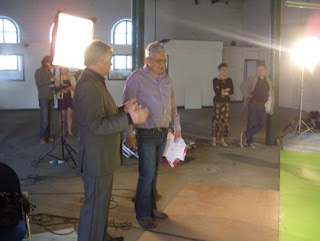 It was great to see Les Dennis in action again. Although he’s spent the last few years as a straight actor, it took him just three minutes to switch back into gameshow mode. He’s still one of the best in the business. As everything was on green screen (that is, added in post-production) he had to imagine the scenery, the cartoons, even the contestants. We also put in a big enthusiastic studio audience behind him with which he seemed to have an uncanny rapport. Sadly we had no means of warming them, or him, up, so Les’s performance was all the more impressive as he stood for hours frozen to the concrete floor.
Last week I took the end result to show the BBC in London. The controller of entertainment said it was one of the cleverest showreels he’d seen: deserved praise for a great collaborative effort. Whether he commissions a series or not remains to be seen. And even if he does, we’d need a proper studio to shoot it in, otherwise, sadly, we’ll all be working outside the region again.

Les arrived with giant Edwardian sideburns and a moustache, the products of J.B. Priestley’s comedy When We Are Married, which he’s currently touring round the country. Getting married is just one of the things Les and I have in common, as we discovered when we swapped notes over an excellent lunch at the Hotel du Vin. We’re the same age, have both been through the tabloid mangle, and now each of us has a wonderful real, grounded partner and a new baby daughter. We’re both tying the knot later this year. I last met Les ten years ago, when the tabloids were having their fill of Amanda Holden’s infidelity. Then he looked a haunted man, and I felt desperately sorry for him. Now he’s confident and happy, and, like me, relishing the new life that true love and a baby guarantees. Thanks Les, and fingers crossed we’ll be working together again soon.
Sunday, May 3, 2009
Tying the Knot
The tickets for our wedding arrived this morning. Not for the event itself – it’s a strictly invitation-only affair – but for the flights taking my entire family, including my 88 year old Mother and baby Izzy, to Los Angeles for the ceremony in August.
To be honest, Joanna and I weren’t planning to risk the stability of our relationship by tying the knot. Having lived together in loved-up harmony for the past five or so years, neither of us wanted to break the equilibrium by exchanging vows. We are already very good at ‘love’ and ‘honour’ and I’ve long resigned myself to ‘obey’; but our friends convinced us that, apart from the arrival of Izzy, there was the “till death do us part” issue: namely, inheritance tax. Apparently wives are exempt from this final grasp of the taxman, whereas live-in partners bear the full burden.
So the invitations are at the printers and the caterer booked. This is the first of my four weddings that I won’t be paying for, thanks to the very kind generosity of my wonderful future in-laws, who are throwing it at their house in Laguna Beach. We’re both looking forward to what will be a joyous informal celebration with friends and family.
It’ll be a sharp contrast to my previous three ceremonies. Last week I found a photograph of my first wife and me at our Tibetan wedding on top of a mountain in the Himalayas with white silk scarves round our necks sitting tanked up with rice beer next to a picture of the Dalai Lama. Exactly one year later we legalized the event in Wandsworth Registry Office. The registrar sounded exactly like Alan Whicker, with a slow nasal drawl, pausing portentously between each syllable: “Do you soh-lem-ly sweeaar?” he whined, reducing us and our half dozen witnesses to helpless giggles.
Then there was the state occasion. Greg Dyke wrote about it in his autobiography. It started out as a quiet country wedding. 350 guests and a quarter of a million pounds later, the firework display nearly set fire to the village. We even had a bishop. The congregation was full of soap stars and celebrity chefs. One well-known actress sat down in her pew next to her agent. “How many photographs did they take of you?” he whispered. “Two or three”, she said. “Get back outside and go round again,” he hissed. And she did. Marco Pierre White cooked the wedding breakfast as a present.
My final wedding will be at sunset overlooking the sea in Jo’s parents’ back garden, with only family and friends, including my divorce lawyer. In fact he and his wife are joining us on our honeymoon. Not because he’s anticipating starting work straight after the wedding (which he pretty much did last time), but because my last divorce was drawn out over so many years, he and I have become very good friends. Maybe his wedding gift will be a pre-nuptial agreement.
Knowing that Jo wouldn’t receive her protection against tax until after the ceremony, last week I decided to protect her position by redrafting my Will. My lawyer gave me a nasty shock. Apparently in the almost certain event I die before her, the new Mrs Gutteridge won’t be entitled to the inheritance tax waiver. Despite forsaking the Californian sunshine forever for the interminable Northumbrian winters and bearing a British child, the taxman insists her legal domicile will always be America. That means that when I go, Izzy’s family home might have to be sold to pay the tax. For the first time in my life I have found a reason to vote Tory: that is, unless Mr Cameron reneges on his promise to increase the IHT allowance.
Mind you, we’re still getting married anyway – we’ve already got the plane tickets.
Sunday, April 26, 2009
The End of New Labour
For once in my life, I wish I could see the future.
Watching Izzy opening her eyes this morning at the start of her 17th week of breathing, first smiling and then giggling as she focuses on my face (the source of her amusement may possibly be down to the absurd way my hair stands on end after a night on the pillow – her Dad currently bears a remarkable resemblance to Ken Dodd), I asked myself what sort of world she faces. Yesterday her grandmother, now a sprightly 88, told me she was extremely worried about the baby’s future; 11 years ago, when my last child was born, she had no such qualms. In those days the world was somehow so certain; now, nothing looks safe.
The other day some students asked me what would be the best part of the television industry for them to join when they leave university. I replied honestly that I hadn’t the slightest clue; already my industry resembles nothing I’m familiar with. The perfect storm of digital television, the internet and the recession has wiped the slate clean; what happens next is anyone’s guess.
So it is with politics. This week New Labour was finally buried by Alistair Darling. In fact, as a political construct, New Labour physically died some while ago, killed not by Brown or Blair or any individual human act, but by the demise of the very circumstances which brought it into life: the opportunities for low taxation and raised public expenditure offered by a strong, growing economy. The recession has washed away the soil in which the New Labour harvest was happily growing and which allowed it to survive scandal and sleaze through three consecutive seasons.
In politics the death of one ideology normally coincides with the rise of another. Not this time. The funeral of New Labour coincided with the cremation of the Tories’ own response to it. Cameron’s policies were based on the very same assumptions as Labour’s and so they too have gone up in smoke. Continuous growth was assured, boom and bust was over; the only argument between the parties was how to divide the spoils. Now politicians, economists, bankers and the electorate are gazing at the same blank sheet of paper. Where do we go from here?
Labour is probably back where it started, in the unelectable doldrums. You can already see the Tory posters for the next election: Labour is the party of higher taxes. But what is the alternative? Whichever government comes into power will be forced to make such savage spending cuts, such difficult decisions about taxation, the world in which Izzy learns to read and write, cut her teeth and sing her first song will be so different from her brother’s that I can’t begin to imagine it.
So how worried should I be about this new world? Well, in one sense I like the blank sheet. Anything is possible if we grasp the future and I do believe the door has opened for a new kind of politics and a new conviction. America already has Obama: this Wednesday sees the end of his first 100 days in power and I swear the air wafting across the Atlantic is now smelling sweeter. In the UK, we too need our messiah, and I doubt very much that someone as out of touch with the real world as David Cameron is going to fill those shoes.
I certainly hope, for Izzy’s sake, that we find that leader. I also hope my innocent wide-eyed daughter doesn’t grow up to see the tired old order, in which the politicians’ policies are based not on conviction but on whatever they think is needed to win over the voters. Or am I, like Ken Dodd, looking at things just a little too optimistically?
Monday, April 20, 2009
I Dreamed A Dream

By this morning the video of Susan Boyle singing I Dreamed A Dream will have been viewed over 40 million times.
You’ve got to hand it to the Britain’s Got Talent team: this was great television, edited like a romantic film, with quirky “comedy” music as she ate her sandwiches and confessed she’d never been kissed and then a huge instrumental climax from the real Les Miserables for her standing ovation. But even without the manipulative editing it was still genuinely touching.
Susan’s voice is nothing special: there are thousands of amateur singers out there with similar renditions of that tired old standard. What Susan Boyle was all about was little to do with talent and everything to do with the audience itself. Close your eyes and think of a beautiful 25 year old and you’ll notice wavering and strained notes. Open them again and see Susan Boyle’s innocent, overweight squashed face and terrible gold lace dress, and the contrast overwhelms your judgment.
This isn’t about her; it’s about us. It’s about the ironic wolf whistles as she comes on stage, and Cowell’s rude eye-rolling when she says she’s 47, and the embarrassed giggling as she rolls her hips and says she wants to be Elaine Paige: Yeah, right, we all say, and wait for her to be shot down. Then she sings, and it’s a wonderful moment, a Paul Potts moment, when the fat man sings and wins. It’s moving because, as Amanda Holden said, “everybody was against you”. The audience had already damned Susan for being ugly and overweight and for presumptuously coming onto its stage. But wow, the circus freak can actually sing, so we’ll layer the soundtrack, cut to a standing ovation, and make the viewers cry. Pure Hollywood schmaltz, and it worked.
The problem is, what should the producers do next? Allow her to carry on wearing those ghastly dresses and no makeup for the rest of the series? Or do they engineer a “swan” moment, and reveal her, eyebrows plucked, straight from the plastic surgeon? If they do, presumably the joke won’t work anymore, so will her voice then be any more special than the others? I guess they’ll keep her as she is until the Final. But won’t that be just as cynical and manipulative?
I encountered a similar problem with my own Susan Boyle moment. A few years ago, I produced a series called Star for a Night. On the first audition day my researchers came rushing in: I had to hear this girl. Hannah Morris was about fifteen, with buckteeth and glasses, nervously clutching the sheet music of My Heart Will Go On from 'Titanic'. She was so tiny; I looked at her in disbelief. Her voice brought the house down and she won the show. But when we came to the final “Best of...” programme at the end of the final series, Hannah had got herself contact lenses and a proper hairstyle. She had a recording contract and was no longer the geeky schoolgirl. Trouble was, she was now nothing special at all.
Sometimes preconceptions work in reverse. We were auditioning in Bristol when, amongst the I Dreamed a Dream wannabes (God, how we grew to hate that track) was a sweet little 14-year-old from Devon with cascading blonde curls.
“I’d like to sing You Make me Feel like a Natural Woman by Aretha Franklin”, she whispered. Our jaws dropped open. If ever there were a mismatch it was this pretty child and that adult song. Then the music started and out came the deep voice of a blues singer. We all cried. The girl was called Joss Stoker, a name she later changed to Joss Stone.

I wish Susan Boyle the best of luck for her future, but exactly whom the producers decide she should turn into for that future, now that’s a huge dilemma.
Sunday, April 12, 2009
Generation Gap
“The crying’s not right yet”, warns Hayley, as she presses “Play”. On the video screen, a young girl is sitting hunched up in the corner of a room. The shadow of a man appears through the window. The girl shakes and starts to cry. It’s an animation; not terribly sophisticated, but it works, and the work is all Hayley’s.
I’m in a classroom in an inner-city college where a group of students are showing me their course projects. This is a group of “unteachables”: kids of around 16 who’ve virtually dropped out of conventional education, the product of urban decay, family upheaval, in some cases addiction and abuse. Many are still illiterate and innumerate. The GCSE system has passed them by, but I’m astonished by what they’ve achieved. In just a few weeks they’ve learnt how to make proper “Flash” animations, with music, sound effects and neat little title sequences with their names proudly emblazoned on the front; they’ve planned, storyboarded, designed, filmed and edited – techniques which in the professional world would take scores of trained experts.
The results are pretty dark. One boy shows me a gang of skeletons catching and mugging a little old lady. The film is half finished. “So, does the old lady win in the end, then?”, I ask naively, expecting her to turn into Supergran. “No, she dies”, comes the response. “Perhaps she could turn into a skeleton as well and then get her own back?” I suggest. “No, she just dies”. Not exactly a Hollywood ending. There’s no artifice with these children; a psychologist would have a field day. Unequipped with the filters that sophisticated artists employ to process their feelings, these trampled lives come straight through the screen. Using the power of film to look straight into the soul.
Over the past few months I’ve been travelling round the North’s universities and colleges looking at how we teach our media students. What’s really amazes me is not how good these kids are, but how little I’ve been taught myself. When I joined the television industry, you needed a degree at a top university before you could be considered for a training course. Producers were the ideas people and, although some of us were directors as well, we relied on other people trained in craft skills to operate our cameras, edit our films, produce our animations and so on. Nowadays we’re in the world of what we call “user generated content” (or, YouTube). Our teenagers do the work of whole movie studios and put them straight on the web. Most of us over the age of 30 are left completely in the dark.
Back at Teesside University, where occasionally I appear under the grand title of Visiting Professor of Media, I recount this story to one of my colleagues. How can I have spent a lifetime getting to the top of my profession and not learnt any of the basic media techniques that a group of deprived 16 year olds have perfected? We’ll teach you, he says. Immediately I snap up the offer and list the skills I never learned that are now standard issue to all media students: editing, graphic design, website building, computer game design and, of course, Flash animation. He sets about organising some training for me and any other dinosaurs I care to invite.
Last Friday in Newcastle I had lunch with some of the North East’s top television producers. When I told them about my proposed re-education plan everyone round the table jumped at the chance. The fightback has begun; old grey dogs are learning new tricks; keeping up with the children is our new watchword. Next we’ll be learning how to use the remote control on our televisions. On second thoughts, that might be a step too far.
Monday, April 6, 2009
Saving The Children
[Madonna's application to adopt a second child from Malawi has been turned down]
It was the rocking that disturbed us most. Until she was almost a teenager Anya rocked herself to sleep, just as she had always done in the orphanage. Anya was one of 150,000 victims of the Ceausescu regime. The Romanian dictator tried to spread communism by artificially increasing the population. He banned abortion and the use of contraceptives and gave financial incentives to anyone with more than four children. The compliant but impoverished population could not cope and dispatched their extra offspring to state-built orphanages. There the children received little education and no love; the healthy were prepared for Ceausescu’s special police; the remainder were left to rot.
These weren’t orphanages at all: most of the children had parents or close relatives who simply couldn’t provide for their huge families. When the dictator was overthrown in 1989, it left the country with a huge problem.
In 1990 I took our programme Challenge Anneka to Romania. I will never forget the sights and sounds of the “orphanage” we chose to help. Or the smell. An intense stench of faeces, urine and decay, which overpowered you at the door. Three stories high, with a dank rat-infested basement, this was home to 650 of Ceausescu’s children. About a dozen staff tried to care for them without resources or training. There were no toys, playrooms, lights or heating, no working toilets and just one shower room with cold water. The kitchen reeked of rotting food and damp.
Each room contained twenty tiny rusting cots, and in each cot lay two children. Some were just skeletal babies, lying in urine-soaked filthy grey bedding; others were much older. Most of the children were too weak to cry; the older ones just sat and rocked. Rats ran around freely. In ten days we transformed its facilities, but the children remained.
Anya’s orphanage wasn’t as bad as the one we converted for the programme. It had toilets and heating. There was a swing in the yard outside. But there was no disguising the rocking. All the children did it.
Our motive for adopting wasn’t altruistic. My wife had discovered we couldn’t have more children, but we still wanted a larger family. Too old to adopt in the UK, we tried Columbia, but found we didn’t qualify. Romania matched our desire for a child with a child’s desperate need for love.
Madonna will almost certainly win her appeal to adopt baby “Mercy” later this week. She probably has the necessary resources and influence to sway the appeals procedure. However I admire Malawi’s concern for protocol. For in Romania, as a result of our television programme and others about the situation, the floodgates opened and thousands of British and American families tried to adopt, not because they genuinely wanted more children, but because of sympathy for the children they’d seen on television. As a result greed and corruption created a commercial international adoption industry, and that is one reason why Malawi is keen to set hurdles even for someone as altruistic as Madonna.
Adoption is the last, not best solution; communities should be helped to look after and integrate their own. But in our case, in a country riddled with debt and corruption, it was the only way forward for Anya and for us. It was difficult: four years without education, comfort or hugs took their toll on her, emotionally and intellectually. But eventually she grew into a beautiful and confident young woman. She is now 21, and last week started her first paid job.
“Mercy” is lucky – she is young, and, assuming she finds a home quickly, the effects of the institution will be short-lived. It’s a shame her experience of family life will be through nannies and an itinerant lifestyle. The poor child really needs a family, not a rock entourage. But almost anything is better than life in an orphanage.
Monday, March 30, 2009
Protest Marches
 I do like a good demonstration. It’s fun to walk down the middle of a road with a banner and a few thousand companions, chanting at empty buildings.
The French are very good at protesting. Just about anything gets them marching: too many British sheep, the cost of diesel, the state of the national airline – there’s scarcely a month goes by without a good Gallic riot. And once the police have squirted a few hoses, the Government usually does whatever the protesters were demanding.
By contrast, the G20 demonstration in London at the weekend was so very British. All brass bands and middle class organic farmers with a nice vegetable lasagna waiting for them in the Aga back home. They marched with their children carrying banners handmade on the wicker table in the conservatory. “What do we want?”. “Jobs! No More Poverty! The End of Climate Change! And, er, Save the Penguins!” “When Do We Want It?” “Now!” It was more street party than political rally.
A few weeks ago I went back to my alma mater York University with Greg Dyke, who’s now the university’s Chancellor. We were reminiscing about our own student protest back in 1972. Those were the days: a decent march over a single issue (the Bloody Sunday massacre), a few arrests, then a sit-in in the Vice-Chancellor’s office – which we were now sitting in with a glass of rather good white wine. We regretted missing out on 1968, when Europe really knew how to demonstrate. I suspect that by Wednesday a few thousand European anarchists will have flown into London to show us Brits how to spice things up.
Meanwhile I’m pleased to report my own little protest is gaining momentum. A fortnight ago I wrote about the lack of network television production in the region. Then last Friday Peter Salmon, the new Director of BBC North, popped up to Newcastle to announce that Tracy Beaker is coming here: 13 episodes of the children’s series will be made on the Tyne.
It’s a really good start, and, having met Peter, I’m convinced he wants to help us. However one series is just a drop in the ocean, just as 3 months every 7 years is scarcely victory for the campaign to bring the Lindisfarne Gospels to their rightful home. We should be marching down the A1 Western Bypass over that one. In fact, for maximum impact, we could combine it with our A1 dualising campaign. “What do we want?” “The Lindisfarne Gospels!” “When do we want them?” “As soon as we’ve built the visitor complex and got a decent road up to Holy Island!”
There are quite a few things in Newcastle I’d get out on the streets for. The streets themselves, for instance. I could imagine putting a brick through the window of the man who invented those absurd “No-Car” lanes. Unnecessary, ineffective and downright dangerous, they force you to weave in and out of the taxis, keeping your eyes on the instructions in the tarmac, ignoring stray pedestrians and other vehicles in the process. If Newcastle actually has a traffic planner, I can imagine him sitting in his office with a map and a pin thinking, What can I slow down this week? Sitting in his in-tray is a request for a road sign at one of our busiest junctions, between the A1 and the A696 road to the airport. He’s left the request sitting there for over two years now, presumably because he doesn’t want to spoil the fun of watching all those tourists going round in circles looking for the way out of the roundabout.
So, What do we want? “The Lindisfarne Gospels, More Regional Television, a New Road Sign, the End of No-Car Lanes, and No More Global Warning! Please.”
Sunday, March 22, 2009
Ski Stories
Every year around 40 people die from skiing accidents. The argument about whether or not helmets should be compulsory is largely irrelevant. At the speeds most recreational skiers zoom around, even a helmet can’t guarantee protection. Skiing is dangerous, and, to me, the most uncomfortable of sports. The news of Natasha Richardson’s tragic death has opened up wounds of personal grief, because I too lost someone very close, and I’ve always felt slightly responsible.
My best friend, best man at my first wedding and godfather to my son, was BBC Newsnight reporter Ian Smith. Tall, handsome, intelligent and incredibly athletic, Ian would turn heads wherever he went. He played tennis to county level and when we knocked a ball about on Saturday mornings he would return my weedy serves with smashes so violent the ball had to be prised from the netting. Ian was completely obsessive about hobbies – he did nothing by halves. When he took up cooking, he wasn’t interested in everyday food: he attempted the most sophisticated recipes and we all had to endure his experimental gourmet evenings. Then, one day in the early 80’s, I persuaded him to go skiing. It transformed his life and eventually killed him.
I myself would never have ventured on a ski slope had it not been for a beautiful woman. At the age of 29 I fell head over heels for a girl who lived in Brussels. Like most people on the continent who can pop up an Alp for the weekend, she was a stylish skier. One day she rang to say she had met a diamond dealer who had offered her the use of his chalet in Verbier. Sensing her excitement and panicking that she might go off with the dealer, I feigned enthusiasm and said I’d love to join her. “I never knew you skied”, she said. “I think skiing’s amazing” I replied, disguising the fact that I had never worn a ski boot in my life. But I did have a cunning plan.
We agreed our date in Verbier then I flew down a few days early and checked into the local ski school. Watching tiny children bombing down the mountain I thought, what’s the big fuss? Such a mistake: I never could understand why you should put all your weight on the downhill ski when every human instinct tells you to just sit down and enjoy the view. Nevertheless I plugged away and, by the time the girlfriend arrived, I could just about manage a shaky snowplough. The first morning she suggested a notorious black run. As we got out of the cable car I fell headfirst into a snowdrift. Through tears of laughter she said it was touching that I’d made the effort. A year later we were married.
I dutifully allowed skiing to share our life and, after listening to us droning on about the delights of gluhwein and mountain views (though secretly I hated the fact that I was always too cold or too hot, and invariably soaked through), Ian was eventually persuaded to join us. He was instantly hooked. Although nearly 40, he took to the sport like a 5 year old.
He became obsessed by powder snow and heli-skiing, and eventually quit his job to spend more time in the mountains. However his body didn’t have the suppleness of his ambition and he often had to be collected from Gatwick with sprained or broken limbs.
One day they brought him home in an air ambulance. He’d slipped over the edge of a glacier and hit his head. Ian never spoke or smiled again. The man who’d been one of the most promising television journalists of his generation spent the last five years of his life in a vegetative state in a home for the incurables. I have never skied since.
Sunday, March 15, 2009
Life and Death in Local Radio
The other day I was the guest pundit on the breakfast show of a local BBC radio station. The format required me to pontificate about anything and everything, interjected by phone calls from listeners.
The morning’s hot topic was a suggestion from some planet-saving organisation that people shouldn’t have more than two children. As a producer I know that what any good programme needs is a bit of a spat so, as both the only guest and someone who’s just become the proud father of his fifth child, I surmised that it was down to me to supply it.
The trouble was, worn down by lack of sleep caused by said Child Number Five, my brain no longer functions in the morning. For some reason the only thoughts that came into my addled mind sounded staggeringly right wing: Britain’s native population is actually decreasing, it’s the immigrant population which is going through the roof, etc. I think I ended up well right of Norman Tebbit. It was slightly scary that most listeners who phoned in wholeheartedly supported me. The radio station seemed to enjoy it too: I’ve been asked back.
I’m pleased because I do love BBC local radio, and have done so ever since I was first sent to work at a similar far-flung outpost as a young trainee journalist. For a rookie full of misplaced superiority and confidence, the experience was a baptism of fire.
The news editor was a bull of a man whose every sentence was laced with swear words, although his authority was somewhat undermined by the fluffy slippers he wore in the newsroom. He was waging a personal war against a madman in the town who ran his own extreme right wing party and who would send us lengthy press releases furiously typed on a very old typewriter (there were little holes in the paper instead of the letter O). When we refused to read them out in our bulletins, he would throw bricks through the newsroom window.
Every Friday lunchtime the entire station would retreat to the local pub, where the journalists spent the afternoon betting their wages in games of high stakes poker. Being the youngest, poorest and therefore least drunk member of the team, I was sent back to write and read the 3pm bulletin. One day I pressed the wrong button and switched the whole station onto Radio Four. Nobody appeared to notice.
The highlight of my stint in local radio was our special extended coverage of the formal opening of a long-awaited road bypass. When I say “special”, it was actually just me in the back of the radio car, a converted estate car with blacked out windows. It looked like a hearse with an aerial on the roof. In fact, local legend claims that it was once used as a hearse. Apparently the sports editor was enjoying an extra-marital relationship with the radio station’s receptionist when one evening he suffered a heart attack and died in her bed. The distraught mistress rang the newsroom and the lads brought round the radio car to pick up the corpse and transport it to the station’s surgery so that they could keep the affair from the chap’s wife.
I tried not to think of this story as I set the radio car on a bridge overlooking the gleaming new bypass and waited for the mayor to arrive for the ceremony. Suddenly a thick fog enveloped the road; I couldn’t see an inch in front of me. So I did what any self-respecting producer would do: I made up the whole thing. I described in detail the police escort, the mayoral car, the cutting of a non-existent ribbon, the first drive along the smooth new tarmac. It was a commentary worthy of a state occasion. It wasn't until I got back to the radio station that I found out the ceremony had been cancelled because of the fog.
Thank goodness the BBC wouldn’t do that sort of thing today.
Sunday, March 8, 2009
East of the Pennines
 Last week’s announcement that ITV is to close its studios in Leeds was a body blow for the North’s television industry.
Not only will hundreds of jobs be thrown onto the scrapheap already created by cuts in regional news, it now means that all studio production of what used to be called the best television in the world will take place in London or Manchester (which may as well be in London, it takes so long to get there on what is paradoxically called the “TransPennine Express”). Put simply, if any of our local producers were lucky enough to invent the next X-Factor or Britain’s Got Talent, they would have to travel to London, Manchester or Glasgow to make it.
A couple of months ago I was talking to BBC Chairman Sir Michael Lyons about the state of our industry. He proudly pointed to the impending relocation of five BBC departments to Salford as an example of the corporation’s commitment to the North. He asked me if I thought it was a good thing. I replied that far from solving our problems, I feared that the stronger Manchester becomes, the more difficult life would be east of the Pennines. “Ah yes,” he said. “The East of the Pennines Problem. I agree it’s something we need to address.” Well, no time like the present.
From the day that Granada took over Yorkshire/Tyne-Tees, the death knell sounded for our region; it was inevitable that everything would consolidate in Manchester. Now the axe has fallen, the only way the North East’s producers will get a voice on our national television will be by commuting on National Express or British Airways – or joining the traffic jams on the M62.
But it’s just possible that some good may come out of last week’s dire news. For the death of Yorkshire Television affects such a huge region, we might just be able to harness the wrath of the white rose to our own end. Northern Film & Media’s campaign, launched in the Journal just two weeks ago, should now be expanded to a North-wide campaign for network television. We need an unholy alliance to wreak political havoc with the broadcasters’ plans.
It worked in Scotland. I was recently in London pitching a show to the BBC. The Controller appeared to like it. We started talking about budgets, which is always a fairly good sign. He then said, rather apologetically, “Is there any way you could shoot it in Scotland?” The BBC now has an obligation to the Scots to produce a proportion of all its programmes north of the Border, and the BBC has fallen short of its quota. Thinking we might find a warehouse just outside Berwick-upon-Tweed to stage the show, I agreed. Sadly that series isn’t going to happen. “We liked it, but felt it was too innovative for a BBC1 audience,” came the rejection.
If the power of the Scottish lobby could lead to the BBC’s massive investment in studios and resources in Glasgow, couldn’t the same trick work East of the Pennines? Scotland only has 5 million residents; the North West, where all studio programmes outside London are now to be made, has only 6.7million. Yet Yorkshire, Lincolnshire and the North East have a combined population of 8.3million and not a single working television studio between them.
This could become a new cultural, political and economic battle and, harnessing the power of MPs from the Tweed to the Wash, we might just win it. Imagine if all British films were to be made in Hollywood – there’d be an outcry. So now’s the time to join the fight for local production. Write to your MP, write to Sir Michael Lyons at the BBC, put pressure on the Government and let the outcry begin.
Monday, March 2, 2009
Happy Beginning for an Old Dog
There’s nothing more satisfying than watching an old dog performing a new trick. As the cheers rang out with the bells of St Boniface’s Church on Saturday afternoon, Craster the border terrier, proudly sporting a new purple collar and lead, led his smiling owner down the aisle. The bride was radiant, young and beautiful, and next to her, with page-dog lead in one hand and wife held just as tightly in the other, was, of all people, Keith.
Those of us on the right hand side of the aisle could hardly believe what we were witnessing.
 At the overripe age of 55 Keith Hann, the grey-haired bachelor whom I first knew at school and now is a fellow newspaper columnist, had finally got himself hitched.
Poor Keith, holed up with Craster in his isolated cottage in the back of beyond – no, beyond even the beyond, almost in Scotland and ten miles from the nearest paper shop – for years well-meaning friends had made vain attempts to pair him off. There was no easier way to liven up a dinner party than to persuade Keith to recount stories of his failed love life. There were hysterical tales of blind dates with utterly inappropriate women, most of whom appeared to have turned into stalkers, nutters or lesbians the moment he met them. He’d been engaged several times, and it’s said that three expensive Tiffany engagement rings lay in his bottom drawer. Jo and I had resigned ourselves to having him on our Christmas Day waifs and strays list forever.
Then, out of the blue, came Maral. I actually thought she was a man at first; or possibly an anagram. For me Maral spelled Alarm, as Keith excitedly showed me her email. Apparently his amusing blog had generated some single female fans in Chester and one of them, Claire I believe she was called, asked a friend called Maral to write to him on her behalf.
Or that’s what the email said. But it was so witty that I’m ashamed to say (ladies, I apologise) it sounded as though it was a jolly jape written by a male friend. Her style of writing reminded me of Keith’s own humour, so I said that if Maral existed, and was vaguely female, he should try asking her out, and ignore the unfortunate Claire. Keith eventually telephoned, then met Maral, and the rest is history; or, rather, the future, as it now includes a bump called Charlie who is due this July 4th.
It was an appropriately eccentric service on Saturday conducted by a quirky vicar who called
 himself Rick the Vic. The congregation sat bemused as, like a stuck record, Vic repeated three times the formal question about whether Maral would take Keith as her lawful wedded husband.
“Are you sure?”, he kept saying, while Keith’s friends were hissing “Get on with it, man”, lest the groom had a change of heart. Some had delayed buying their wedding presents in case he failed to show, and Maral told me she was quite expecting to have to tell the wedding car to drive round the block a few times if he got cold feet.
In fact, it transpired that Rick the Vic was following the Iranian custom of asking the bride three times if she wanted to proceed. For Maral is Iranian, or as one lady whispered to me in Church, “Did you know, she is a loose Muslim?” I think she meant lapsed.
If opposites attract, this couple must be fused together. Maral: young, attractive, sociable, Muslim; Keith: Thatcherite, curmudgeonly, the world’s grumpiest old man. Yet they found they possessed the most powerful aphrodisiac: a shared sense of humour. Keith said in his wedding speech that since he met Maral, he has never laughed so much in his life. It shows.
Monday, February 23, 2009
Television Is Dead...

On Saturday night at the Sage in Gateshead the North East’s media elite assembled for the annual Royal Television Society Awards. It wasn’t quite the Oscars, but it was still an impressive shindig, with nearly 600 guests, ranging from veteran producers and local celebrities, to hopeful media students. Every UK region holds its own television awards ceremony, but ours is by far the largest, an astonishing fact considering our producers make the least number of programmes.
Last week Northern Film & Media, our local screen agency, launched a campaign to save our local production industry. It's not a moment too soon. They showed us some pretty bleak statistics: Wales, with a population only slightly larger than ours, produces thousands of hours for the UK’s broadcasting networks, whereas we produce almost none. In this region we fork out £134 million a year in licence fees, but the BBC commissions not a single North East network programme. It’s a shameful state of affairs. This region has creative talent spilling out of every pore, but its television industry is invisible in the national marketplace.
Blame for this decline has been laid largely at the door of ITV; I’m not sure this is fair. I think I know how the rot set in. It was in 1992 when, as newly elected chair of the film and television producer’s body PACT, I decided to launch a campaign for regional production.
I guess it was mainly guilt. Having been brought up on Tyneside, and leaving to join the BBC at the age of 21, it didn’t occur to me to return to my roots to work in the region. Like so many northern professionals, ambition and family had settled me in London, but I wanted to do something for my colleagues back home, because I knew how hard it was for them to breach the walls of Television Centre to get their ideas commissioned. Here I was in London, with hundreds of hours of juicy programmes, and my regional colleagues were getting the scraps.
So almost the first thing I did as chairman was ring up John Birt, who had just become the BBC’s director-general. I’ll never forget the call, or the circumstances. I was in The Ivy (where else??), and he called me back after I'd left a message with his assistant. I'm only setting the context, because what he told me on the phone was so utterly shocking I can still picture myself reeling with disappointment against the wooden panelling. I told John that we wanted the BBC to do something to increase the commissions for producers from outside London. He replied, “It’s not the BBC’s job to protect regional production; that’s what ITV is for”. I probably ordered a very large glass of champagne to calm me down.
That simple sentence sounded the first death knell for regional producers. As if to underline his point, shortly afterwards he closed down all the thriving local BBC features departments, the source of wonderful local programmes over the years, and more importantly the training ground for budding producers, directors and cameramen who, by an unfortunate quirk of fate, found themselves born north of Watford. The features department used to have direct links to the networks; now all BBC regional programmes were to come through the news division. Basically, if it wasn't a factual documentary which fitted in with the news agenda, they weren't interested. No entertainment, no features, and certainly no drama or music programmes. It was the beginning of the end.
This response fired our regional campaign, which we won hands down: the BBC was forced to set aside 30% of all its production spend for non-London producers, and in 1998 this quota was extended to Channel Four. But despite having an obligation to commission, the BBC accepted no responsibility for maintaining the supply chain. It had already destroyed its regional infrastructure of training and support that was essential to nurture local producers into the network fold, and it didn't offer anything in exchange.
Leaving the job to ITV ultimately proved disastrous: for when Tyne Tees was bought by Yorkshire, and then both became part of Granada, it was inevitable that network production would be focused on the larger companies, rather than the remoter corners of the empire. As a network force, the home of The Tube, Highway, Supergran, and hundreds of hours of network production, including quality drama, the spirit of Tyne Tees withered away. They shut their big network studios on City Road and moved their
news operation into an office block in an industrial park.
From then on Tyne Tees could only offer our producers a meagre supply of local documentaries (produced on budgets less than 10% of network prices). A friend of mine has made 30 documentaries over the last few years for Tyne Tees at an average budget of just £12,000. Last year I made a single non-broadcast pilot for a network show which cost £600,000. And I doubt the series will ever be made. That's the chasm between us.
Local producers have worked wonders with these derisory resources, but recently the axe fell on even this small consolation. ITV is no longer commissioning local documentaries, so from now on they’re on their own.
So on Saturday night, as the final batch of regional programmes competed against each other and Wire in the Blood received its last ever nomination for Best Drama, there was anxious talk across the ham and pease pudding canapés about the future.
Yet, amazingly, it wasn’t all gloom; there was a real determination to fight on together. One well known actress from Emmerdale stood up on stage and issued a rallying cry for us to keep on going, even though by then she'd clearly had more than a couple of glasses of RTS champagne, she brought the house down. It was a theme echoed by all the award-winners throughout the evening.
Our producers now need the support of all our politicians and opinion formers. The creative industries will be the heart of what the government proudly calls Digital Britain; it’s vital that our region will be part of that future. Watch this space.
Monday, February 16, 2009
My Censored Newspaper Column
[My usual weekly column in Newcastle's daily newspaper The Journal didn't appear this morning. My editor gave me the following explanation:
"Tom, I've decided not to print your column tomorrow. Disparaging newspapers and those who write for them should not be the work of Journal writers, however contemplative they intend to be."
For my regular readers, here's what you missed.]
The problem with writing a newspaper column is the deadline. I’d love to be writing on Monday morning as you read this, so you can know my thoughts about things that are happening right now (your right now, not mine, because my right now will have happened several hours ago).
I mean, who knows what excitement could have occurred in the intervening hours while The Journal’s presses are churning away and the vans drive through the city to your newsagent. Another of our banks (yes, the banks we now own) could have accidentally lost us another £8 billion; a third plane could have nosedived into a city; Gordon Brown could have smiled (unlikely, I know, but hey, it’s been a surprising few weeks).
But I guess if you really wanted to know what I was doing or thinking right now, we’d be using Twitter. There, I’ve said it: the T-Word. I’ve absolutely no idea how or where you “twitter”, or why it’s called “twitter”, but everyone I speak to is talking about it, if not actually twittering, so I thought I’d mention it this week to be part of the club. Obama twits (or is it tweets?), and so do Ross and Fry. It’s a social networking thing where the only communication you have with your friends is telling them what you are doing or thinking. In 140 characters or less. On your mobile phone. Goodness, modern life is exciting. How did we live before Twitter?
So, What Am I Doing Now?
"I’m actually writing these thoughts in the contented afterglow of Valentine’s Day."
That was only 81 characters, so I’ll add: "With 3 of my 5 children, including baby Izzy, and partner Jo."
Somehow the space restriction doesn’t encourage a satisfactory reflection of my feelings of bliss engendered by watching the family playing together, separated by three marriages and 27 years; or my continuing amazement at Joanna’s beauty as she smiles at baby Izzy snuffling at her breast. My world is now complete, the ultimate Valentine’s present. It’s enough to stimulate the green shoots in a recession.
Speaking of which, I know something good is on the way the way because of the tweets. Not the messages sent on Twitter (which really are called tweets), but the birds in our wood, which have gone quite twittery over the last two days. They know it’s soon to be the end of this cold, heartless winter. And according to the man in the country store, loud tweeting means early Spring.
I’m surprised I’m feeling so positive. On Thursday night I was at a dinner party with the leaders of quite a few media organisations, and, gloves off, we all said what we really felt about the recession. Gloom doesn’t describe the collective feeling. The consensus was that we’ve seen nothing yet and it’s going to get a great deal worse. It’s enough to make you go off and live in a farmhouse in faraway Northumberland. Which, as luck would have it, I do.
But the assembled gathering also felt that, aside from utter cowardice of our bankers, what’s really holding back those green shoots is public confidence. We’ve all got our heads under the duvet, waiting for winter to end, and until we pop them out and tweet like my birds, it never will. It was also felt that the last people to spot the upturn will be the journalists, and especially the newspaper columnists. News likes gloomy; good news doesn’t sell papers.
So as soon as I’ve worked out how to do it, I’m going to get Twitter. Because I want to know what real people are doing and thinking right now – not the bankers and politicians and journalists. Because that’s the key to the end of this recession. And the moment there are some positive vibrations floating around I’ll let you know. Albeit a few hours later.
[As you will surmise, the reference to journalists was actually made by others at the dinner, attended by some senior broadcasters, publishers and journalists, together with a number of academics. Because it was a small private dinner held under Chatham House rules, I can't reveal who said what. These thoughts are also echoed to a certain extent in an article on Twitter in today's Media Guardian - where it's revealed that switched on journalists are now using Twitter to get information about popular culture and the mood of society.
In one way, I'm rather relieved this wasn't published, as the piece is far from my best work. I suspect that familial contentment doesn't make for spicy writing. However, I don't really see where the slight against journalists appears, other than my cheap and unnecessary cliche about good news not selling papers. I don't actually believe this axiom, particularly not in the case of The Journal, which provides an excellent service for the North East and specialises in front page splashes about major local achievements. It also holds celebratory campaigns for the good things about life in the North, like its food and many natural assets.
However my real point, albeit sloppily made, is about the social climate, and how we can spot changes in what people want and think if we keep or ears to the ground; it's a theme mentioned elsewhere in this blog, for I believe that one of the primary jobs of a television producer (and also a journalist) is to sense the popular zeitgeist in advance. After all, we're pitching shows which won't be seen for a year or two, and we want them to be enjoyed - so predicting public taste and fashion is part of the job. As a consequence searching for green shoots in these dark days is an important goal - we can't rely on the house price index or unemployment figures. These indicators reflect what has already happened. What's interesting is what is happening now - and that's where Twitter could come in handy.
Incidentally, one person at the dinner suggested that it should be the BBC's role to provide uplifting content for the nation in its hour of need, rather as the British film industry tried to do in the 30's. I pointed out that at least one country in Europe had an alternative solution to the depression, which was fascism. Perhaps more episodes of Strictly Come Dancing might have a positive effect. Or maybe Bruce Forsyth should become our Fuhrer.]
Monday, February 9, 2009
Selina Scott to the Rescue

Seeing the ruins of Lord Steven’s garden fence beneath my dented car on Monday night, I was reminded me of another fence I mangled some 25 years ago.
In 1984 I had a little red sports car, a Mazda RX7, which I used to drive at absurd speeds whenever I had the opportunity. At that time I was still working for the BBC, producing a BBC1 dance series called The Hot Shoe Show, with Wayne Sleep and Bonnie Langford. That series had brought me into contact with Andrew Lloyd Webber for the first time, and I’d just directed a video of his musical Song and Dance. The Hot Shoe Show was in its second season, and had an incredibly complex and exhausting schedule, but I still said yes when Andrew asked me if I’d moonlight to direct a video of Unexpected Song with his new wife Sarah Brightman. So it was that after a long day in the office in Shepherds Bush, I’d hit the M4 and drive over to Sydmonton, his Victorian pile on the edge of Watership Down in Berkshire to plan the shoot.
As I’ve never been one to knowingly arrive early for anything, I used to force my Mazda to ridiculous speeds in order to make up time once the road had emptied itself of rush hour traffic. Just after Reading there’s a stretch of motorway which runs without an exit for about 13 miles. It must be one of the most boring stretches of motorway in the country.
One evening I was cruising in the fast lane at well over a hundred miles an hour, and I was about ten minutes from the Newbury turning to Andrew’s house. I was finding it hard to keep my eyes open and had to turn the air vent onto my face to stop myself nodding off.
Then I felt a bump, and blinked hard. A pair of Wellington boots was flying in slow motion past my windscreen, followed by a kettle, some large lady’s underwear, and then, held weightless in suspension as if in a space capsule, a cloud of small household items. It turned out to be the contents of a small white caravan which I’d apparently shunted up the rear, and which had managed to absorb some of the impact of my car. Over what seemed like about thirty seconds (but in truth must have been a fraction of this time, for the adrenalin in a road accident causes everything apparently slow to a snails pace) I pushed caravan and its unfortunate owner off the road. The driver of the other car and his wife, quietly motoring to a week’s holiday in Devon, must have had no warning. One moment they were gently pootling in the middle lane, as caravan owners tend to, oblivious to everything else but the Archers on the radio, the next they were being pushed out of control towards the hard shoulder.
I’ve driven this stretch of road many times since, and I’m amazed at the narrow escape we all had. At the point where the accident happened there’s a steep ravine to the left of the road. Immediately afterwards there’s an equally steep embankment about a hundred feet high. In between the two runs a small ramp of grass and trees, like a sliproad no more than ten feet wide. One second earlier and we’d have been over the ravine, with a fall of into the river below; a second later and we’d have hit the hill and overturned. As luck would have it, with just a couple of feet on either side, my car pushed us all up this narrow ramp. Slowed down by some newly planted trees, we came to rest at the edge of a field. I can still picture the broken fence post in front of me, and the steam pouring from my bonnet.
I got out of the car, and went to check the others. Luckily noone was hurt, but the caravan had disintegrated and both cars were written off.
“What happened?”, said the confused driver, a man in his 50s who worked for the gas board. Avoiding the temptation to apologise and say I must have fallen asleep and driven into his mobile sitting room, I merely repeated, “What happened?”
Together we made our way down to the motorway. Traffic had come to a halt as people stopped to gape at the carnage. Except there was no carnage, just two cars and a few bits of tangled metal in a field.
“What happened?” The words spread round the onlookers. Someone found a bit of white caravan by the roadside with a blue scratch on the side. Then someone else said he had seen a blue van drive off after the accident. And then the police arrived.
They were terribly polite. They took our details, examined the debris and called for a tow truck to extricate our cars from the field. By now the “witnesses” had embellished the story. Apparently a blue van, going much too fast, had struck the caravan and knocked it into the side of my car, pushing both vehicles off the road. The policemen nodded, and wrote things into their notebooks. They radioed the details of the blue van. I kept quiet.
“And what do you do, sir?” one of them asked.
“I work in television”.
His notebook closed. He lowered his voice and said into my ear, “Do you by any chance know Selina Scott?” Selina was in those days the host of BBC Breakfast News and by far the most desirable female celebrity in Britain: to police officers, anyway.
“Actually, I do – we worked in the same department for a while”.
“Do you think you could get her autograph?”
“I’m sure there’s no problem, officer.”
We were standing beside a smashed motorway marker sign. Coincidentally, it appeared to be exactly the same colour as the blue scratch down the side of the bits of caravan. The same blue as the missing van. The policeman studied it carefully, and wrote something down in his book.
Just then the tow truck dragged my car out of the field. It came to rest beside us. There, embossed on my rubber front bumper, was the imprint of the number plate of the caravan. Clearly my car had struck it precisely in the rear.
The policeman frowned and turned to me again. “Of course, sir, if you hadn’t been hit by that blue van; if, dare I say it, you had fallen asleep at the wheel, and you’d driven into the back of that poor couple’s caravan, now that would be quite serious. It would in fact be called dangerous driving.”
I nodded sadly, as more bits of broken blue sign were extracted from the remains of the caravan.
“Could I have a private word, Sir?”
The policeman led me up the side of the motorway.
“The thing about dangerous driving is, that it’s incredibly difficult to prove. Usually, it’s just not worth our time. Now, are you absolutely sure that you can get Selina Scott’s autograph?”
Two months later I got a letter from Thames Valley police. It apologised for the fact that they had been unable to trace the third party in my unfortunate accident on the M4: despite exhaustive enquiries they were unable to find the blue van.
That was my first and last road accident. Until last Monday, that is. Tomorrow I take the Volvo into the “Mill Car Clinic” for an estimate. It’s been an expensive week.
[By the way, regular readers of this blog might like to know that you can "follow" its contents regularly by clicking on the Follow This Blog link on the right. Or you can "subscribe" by clicking on the appropriate link. Or post a comment - I'd appreciate your feedback.]
Subscribe to:
Posts (Atom)