Sunday, June 27, 2010
Germany 4 England 1
It’s tough enough playing a sport against the world’s finest; having an entire nation screaming at you must require the utmost mental discipline.
Sometimes I wonder if we ask too much of our young sportsmen. Nearly-fully grown men, whose only talent in life is to kick a ball in the right direction, find themselves the objects of derision and hate, or can be raised to god-like status, in the twinkling of a goal net.
My eldest son is becoming a film director. He’s training himself by making commercials. He’s young, fresh, and in demand and hopes to become the Rooney of his industry. Every now and then he pitches an idea to a client, competing against other directors at the very top of our advertising industry.
I try to think what his life would be like if, every time he writes a script, 10 million people were sitting in pubs watching him type, drunkenly criticizing every line.
“That’s a rubbish strapline; why on earth did he pull focus there; he should have cut to the girl three seconds earlier”. Imagine his mental state if he knew the newspaper hoardings would scream Ben’s Blunder when he fails, or Ben’s Blinder when he succeeds. When he goes onto a film set, perhaps the youngest and yet most senior member of a 50-man crew, what if his producer roared out instructions and obscenities from behind the camera, echoed by 60,000 cheering, jeering spectators? No 20-something could cope with that kind of pressure, so it’s no wonder our England players haven’t had the easiest of rides.
Despite being a Scot, Andy Murray must have been saying prayers for England to keep on winning. As long as they survived, he’s been playing his games in a sideshow, relegated to the back pages. This England defeat means, once the nation has sunk its gloom in alcohol and recrimination for a few days, the pressure will turn on him. We love sporting heroes. We have so few of them, sadly, that when an event comes around where we can get behind someone, we do it with such passion, we often forget that the object of our support is a real human being.
They say the most valuable item in a sportsman’s kit bag is the ability to overcome fear of failure. Being able to control that fear is as important as maximising skill. The moment fear begins to manipulate the mind, confidence folds, the service ball hits the net, the open goal becomes a fortress. And once the fear of failure leads to failure itself, something we became only too familiar with at St James Park just over a year ago, then losing becomes inevitable.
It’s one of the reasons I was never any good at any sport at school; that and arrant laziness. My father was a professional football referee and played cricket for Surrey. There’s no way I could kick a ball or pick up a bat without it becoming some sort of professional trial. I know I was a bitter disappointment to him and I can still recall my fear of his frustration. Today I still can’t throw, catch or kick a ball, but boy can I shout at our national team.
It’s a big ask, but we, the fans, can help. Our honour’s list of sporting heroes hides many tales of depression and mental illness. Their fear of letting people down; their fury at a body which, through injury or fatigue, fails to fulfil overblown expectations; their lack of support from the pundits whose only advice is “pull yourself together”, has often led to serious problems, particularly for young men trying to live up to headlines and hyperbole.
Come on Rooney, we shouted today over our beer bellies. But at the end of the day, he’s only human.


Sunday, June 20, 2010
Bringing Me Down To Size
Tighten your belts. That’s the message from our Chancellor tomorrow. After decades of overindulgence, we’ve all got to pull them in by a couple of notches.
Well, I’ve got news for you, Mr Osborne. I’ve tried – oh how I’ve tried – and I simply can’t get mine any tighter. Not without asphyxiation. You see, I’ve so overconsumed during the last 20 years, I’m now plain obese.
It came to a head in LA. There I was, optimistically pitching a show for young people to the relentlessly trendy MTV, when it came to me that I wasn’t convincing anyone in my black shirt and Ferragamo loafers. To these bright young things I could only have looked like an old, grey, fatty.
To make it worse, my mother-in-law has published pictures of me and Izzy on Facebook. I used to be embarrassed by my own father, who was also a considerably overweight man in his fifties. Last week I found a picture of him proudly holding me when I was 18 months old. I was appalled to see that he undoubtedly weighed less than my current 15 stone 5 lbs.
So I’ve resorted to drastic measures. Woman’s Hour has offered me a solution. The other day they featured a Frenchman called Pierre Dukan who has a revolutionary weight loss programme claiming 1.5 million devotees, including Gisele Bündchen and Jennifer Lopez. Apparently they’re all enjoying the ultimate dream: eating whatever they like in a permanent state of slimness. Dukan’s diet offers permanent weight loss despite consuming limitless amounts of proper food. You start off with a few days of eating only protein, then add in some vegetables for a month or two, and, bingo, belts tightened forever. In fact, you have to buy a new, smaller belt, because you’ll never need the big one again.
Normally I’d pass this off as another fad, but the BBC, in their unrelenting quest for balance, felt they couldn’t just give Dukan a free puff and paired him against a killjoy from the British Dietetic Association. She burbled on about the dangers of a protein-only diet and how nothing was as good as controlling calories and exercise.
What utter tosh. We’ve all been trying that for years. Our trained dieticians refuse to accept that people like me will never have the gift of willpower. We’ve been putting on a pound a year since we were 25 and no amount of advice is going to change us: we need a long sharp shock. Her smugness made me so cross, I vowed to give Dukan a go – but not till I got back from LA. Nothing was going to stop me enjoying the French toast, barbecues and wonderful red wine at my brother-in-law’s house, with portions as big as a house.
I started the diet on Thursday. After three days, I can report that it’s absolute hell. I’ve had nothing but plain meat, fish, water and fat-free yoghurt. I endured our World Cup disaster down the pub with a diet Coke (do you know how disgusting it tastes?), eschewing, not chewing, the chef’s fantastic fish and chips. On Saturday night I watched a lot of happy people getting wondrously drunk and gorging themselves at a neighbour’s party. I’ve even started a new blog, http://bringingmedowntosize.blogspot.com, to record the whole ghastly experience. Dr Dukan says my ideal weight is 12 stone 13 pounds. The way I’m feeling right now, I’ll be dead long before that.
Fortunately my resolve was strengthened by my darling wife’s clever Father’s Day present: a gift certificate for a local photographer, who’s coming to the house to take family portraits. The sort of pictures you hang on the wall and enjoy for years to come. I’ve got three weeks to transform myself. And buy a new belt.
Tuesday, June 15, 2010
A Visit To The Dentist
It started wobbling last Friday afternoon. Like a child’s tooth awaiting the imminent arrival of the tooth fairy, I could easily wiggle it to and fro. I implored the fairy not to come too soon: the tooth was near the front and I was in the middle of a series of pitch meetings with important television executives.
It was during one of these when I first noticed the problem. I was trying to sell a show to a man with no hair but impossibly shiny molars, which appeared to fill his suntanned face every time he smiled at my idea. I think he must have liked the concept, because his smile kept flashing at me across the room. Suddenly I became aware of my tongue catching on the side of my tooth, and I distinctly felt movement. And the more animated I grew, trying to raise his excitement in my must-have project, the more the wretched thing quivered. My tooth appeared to be loosening with every sentence: I spent the rest of the meeting trying to speak without opening my mouth. I would have made a lousy ventriloquist.
I hadn’t really noticed quite how bad my teeth were, metal lined and yellowed from years of red wine and coffee, until ten years ago when a broken filling forced me to an emergency appointment with a Hollywood dentist. The chap starred into the abyss of my mouth and said with undisguised pity, “You British, you’re all the same. Where would you like me to start?”
In California, where every mouth is a gleaming array of neat white perfectly spaced porcelain, my teeth stand out like Stonehenge: grey, neolithic standing stones set at odd angles, fighting themselves for occupancy of the overdeveloped gum space. British teeth, magnificent examples of 50s neglect.
Apparently it would take him three months and tens of thousands of uninsured dollars to rectify my smile. Just fill the tooth, please: but it was too far gone to save. Instead he fitted a rather neat crown – so neat, in fact, that I completely forgot all about it until this week. How that crown-maker must have sighed when he saw the order form – less pearly white, more the colour of macadamia nut. But when it joined its new neighbours in my mouth, it blended in like a local. There it lay, undisturbed, for ten years, chomping happily away, until last Friday. Sure enough, when I looked in the mirror the Hollywood Crown was the source of my wobble.
I spent the weekend fretting. Do I leave it alone, and hope it lasts till I reach the safety of the National Health Service, or head off to a dentist first thing on Monday morning and have it glued back in? Having no medical insurance in the United States, my wallet was praying it would last. But the thought of it coming out in the middle of a meeting with the president of NBC was just too awful.
The decision was made for me. At a barbecue on Sunday, in front of a group of complete strangers, it suddenly made its break for freedom and popped into a glass of rather good red wine. Suddenly I looked like the victim of a mugging. The people at the barbecue, some very nice friends of my brother-in-law who’d invited us to watch the Lakers game – were very sympathetic. Our host provided me with a little plastic bag to hold the tooth in and everybody pretended not to stare, even when I laughed.
So it was that on Monday morning, my crown and I headed off to be reunited at the Thousand Oaks Dental Practice. For those of us accustomed to the British version, American dentistry takes a bit of getting used to. In Britain, you book an appointment with a dentist, he says hello, sticks your crown back in, hands you a bill and you’re on your way in about five minutes. The American process took nearly an hour and a half.
On the face of it, the surgery was incredibly well organised. First I had to fill in my details online (“to save time registering”). Then when I arrived, the receptionist made me check the form I’d filled in. I sat in the waiting room for a while until a young woman dressed like a surgeon in a gown and a mask came to get me. She made me lie down on a couch and was about to set to work when, upon showing her the contents of my plastic bag, she paused and frowned. She had to consult Doctor K.
Five minutes later she returned, and took an X-Ray of my gap. In the old days you had to stick a piece of card in your mouth, which always hurt your gums, and then come back in a week to get the result. This was instant, and on a television screen in front of me. It caught two or three other teeth surrounding the gap where my crown had been – they had clearly been in a fierce battle for supremacy in my jaw as the roots had been pushed in all directions.
I was waiting for her to pop the crown back into the gap when she said I had to stand up and go to another room to see Doctor K. I guessed she was only the X-Ray taker. I think she was disappointed I didn’t need a full set.
In the next room she lay me down on another couch and left me for what seemed an age. I’d nicely nodded off when I was awakened with the jolly shout of “Hi, Tom”. Why is it that American doctors are so – friendly? None of the polite formality of the British dentist/customer relationship. Instead, it was like being in a sports bar with a rather loud basketball supporter.
“Let’s have a look at it then, Tom”, he went on brightly, looked at my gap and said something to the effect of “It’s a Goner”. He told me the roots were wasted away and that I needed a bridge or an implant. I had no idea what either were, but they sure sounded expensive and there was no way it could be done that afternoon. I asked him if he could do a temporary fix-up and he agreed, then promptly left the room again.
Five minutes later, a lady in a suit came in clutching a clipboard and sat down. She spoke like a divorce lawyer, quietly, sympathetically, but deeply serious and with perhaps an undertone of disapproval. She studied her notes. Your treatment will cost $90, she said. Did I have insurance? When I said no, she frowned. I thought she was going to ask me to leave. I wasn’t sure if I was supposed to negotiate, but $90 was actually far less than the $200 or so I’d expected it was going to cost, particularly as I’d already been there nearly an hour. “It’s OK, I’ll pay cash”, at which point she relaxed and left.
Another long pause, and this time I had completely fallen asleep, when in bounced Dr K with a loud “Right, Tom, let’s get this moving”. It took him just a couple of minutes to smear on the cement and pop in the tooth. Then he left again.
This was getting very tedious, and I sighed when Miss X-Ray came back in the room, unwrapping one of those spiky metal things. Why is that, in 2010, dentists still use instruments that look as though they were invented in Victorian times?
She scraped away, I tried not to bite her finger, and she unglamorously scraped pieces of stray cement off my tongue. Then she left again.
It was another ten minutes before Dr K bounced back in. It took him just ten seconds to finish the job – removing the last bits of cement, flossing the gap, and telling me, Tom, it was all over.
All in all, it was a curiously long-winded way to pop a crown back in. I guess Dr K had half a dozen clients on the go at the same time and that this was the most efficient way of handling them all. But I’m afraid conveyor belt dentistry is definitely not for me. Mind you, at least I can smile again till the next wobble.
Sunday, June 13, 2010
Why Americans Don't Get Soccer
The baby stared blankly at the television. England players were hugging each other after Steven Gerrard’s goal. Ella may be half American – her mother Marla is my wife’s best friend – but to Matt, an ex-pat history teacher here in Los Angeles, there’s only one team she will ever support. Forty minutes later, Ella, still staring at the screen, silently changed her nationality back to American. Green’s goalkeeping gaffe was all too shocking. Even she could have held onto that ball.
It wasn’t our finest hour-and-a-half. Matt and I were the only English in a roomful of Yanks. We were still patiently trying to explain the offside rule to our ex-colonial friends, who were only really interested in talking about the Lakers game, when disaster struck. We spent the rest of the match shouting at our manager Capello.
How could we only tie with a country that doesn’t even understand the meaning of the word “draw”? Apparently real sports, like baseball, always have a winner. You just go on playing until there’s a result. In 1981 one minor league game went on for 33 innings. Mind you, they also don’t understand why Beckham can’t play for the USA (“But surely he plays for LA Galaxy?”) and they don’t get the concept of league tables at all. “So this means nobody won, right – so who goes through?” Oh, forget it. Matt and I glumly opened another bottle of Newcastle Brown.
During the game we worked out the fundamental difference between Americans and the rest of us. I reckon it’s all down to attention span. In America all sports have a series of repetitive events occurring roughly every thirty seconds. Baseball: Man throws baseball at bat, bat hits ball and Man runs; or not. Football: Lots of Men with padding get ball forwards by ten yards; or not. Basketball: Very Tall Man pops a ball through a hoop, then another Very Tall Man with a different tee-shirt takes a few steps and pops it into another hoop; or not.
You can join a game at any moment and there’ll always be someone about to succeed or fail. No wonder they find soccer boring. “So the aim is to get the ball in the back of the net, right? OK – I get that, so how come nobody’s doing it?” Americans are delightful, friendly, open, passionate, honest people, but when it comes to the big things in life, like football, they might as well be Martians. And now we can’t even beat them at our own game?
You'll gather I know nothing whatsoever about American sports. Tonight my friends are putting that right: I’ve promised to sit through their Lakers basketball game. They say they’ll convert me, but somehow I doubt I’ll have the patience for balls popping through hoops 150 times in one sitting. Not without a lot of Newcastle Brown, that is.
After the World Cup fiasco I was taken to see a phenomenon that could only happen in America. In a Hollywood recording studio hundreds of proud parents were craning their necks to see their children in fully-formed rock bands – with a stage, lighting, roadies, stamps on the wrist to get in, the lot.
The children had been coached by real live rockers with names like Muddy and Slick. They were actually rather good. Star of the night for me was 8-year-old Max in his band called The Rockaholix. As Mom beamed and Dad videoed from the wings, tiny Max, complete with dark glasses, peered over an enormous drum kit hammering away like Keith Moon. He was brilliant. I suspect it will make Izzy’s first school play – which I’m already excited about even though it’s still four years off – seem rather tame.
Monday, June 7, 2010
Lessons From a Screeching Child

Oh no, here it comes again. One deep breath and suddenly the Sunday lunchtime hubbub in the Ox Inn is cut to silence by a scream so blood-curdling, you’d swear someone had seen a ghost. Cutlery is dropped in shock, elderly women tut their disapproval. The sound is beyond loud: it’s earsplitting. Sheep four fields away stop their chewing and bleat in alarm. Izzy has dropped a carrot.
I’m not quite sure where she learnt this new technique. I don’t recall my first four children expressing themselves this way. At 16 months Izzy has discovered the voice of a diva, and boy does she like to show it off. The busier the restaurant, the louder she screams. Then, carrot replaced, she magically transforms herself back to an angel.
I guess advanced age has tempered my memories of child-rearing. My wrinkled brain will only recall images of quiet babies politely chewing their rusks as the grownups debate politics and football over long social lunches. Of course, it was probably never like that: I guess you just erase the bad recordings. Or maybe I was so engrossed in my obsession with career-building, I never really took enough notice of my children growing up.
The changes are arriving thick and fast now. This week I’m going to Los Angeles for some meetings with broadcasters about a new programme idea; I’m not looking forward to it, partly because I’ll have to watch England play the United States in the wrong country, but mostly because I’m scared I’ll miss some crucial new Izzy development.
Yesterday she had her feet measured for her first proper pair of shoes. She now runs as well as walks, but always in the opposite direction to where we need her to go. Our formerly open-plan living area is now a maze of child prevention barriers; coffee tables and low shelves lie empty, waiting patiently for the end of toddlerhood.
Izzy’s language is now so advanced she reels off whole paragraphs of gobbledygook. She’ll stumble up with a big grin on her face, stare at you with her big blue eyes and reel off a passionate lecture of totally coherent gabble. She’ll wait patiently for you to answer her, and then nod her head in approval before toddling off to tell her extraordinary story to someone else. But not a phrase of it uses any human word I recognise. It’s a wonderfully sophisticated private language known only to her, and my stubborn attempts at humanising it, by pointing at Truffle and endlessly repeating the word “dog”, have been completely ignored.
Headstrong doesn’t begin to describe my daughter. “And where do you think she gets that from?” asks my wife.
Watching a child grow is like tending a Northumbrian garden. Every day brings a new wonder and, because our seasons are so short, you can’t bear to miss a single flower. You want to freeze in time each new scene, but sadly there’s no still-frame facility. For the last thirty years, my timetable of life was dictated by projects and paydays; now there’s something immensely satisfying about sitting back and watching the natural order of life unfold.
After all, if there’s one thing that the appalling news from Cumbria this week will have taught us, it’s just how fragile and transitory human life can be. If simple, innocent lives can be taken away so easily and unexpectedly, if the security of the safest, happiest community can be destroyed by one hour of madness, the least we should do is to taste and treasure every single moment we have left.
Sunday, May 30, 2010
Inside the Gates of Hell

In the gas chamber we stood in silence, taking in the horror.
A camera flash broke the moment, but no photograph could possibly reproduce the sick feeling in my spine: the disbelief that anyone could design with such evil efficiency the death of a fellow human being.
With clothes removed for fumigation in smaller gas chambers, the selected prisoners, told that they were being cleansed and de-loused, would be led into a room with the optimistic sign Brausebad – Showerbath – over the door.
Sure, there were showerheads in the ceiling, but none attached to a water supply. The door was locked and the pellets of Zyklon B, pushed through a small hatch in the wall, would do their work in fifteen minutes of wretching agony. A tiny peep-hole in the wall enabled a guard to check the killing was complete; then the bodies would be heaved out onto the pile waiting f
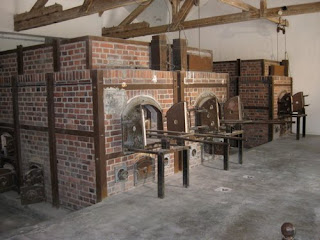 or the ovens next door, cremating all evidence of life to dust.
According to the tourist guides, Dachau’s gas chamber was never used for mass extermination. It wasn’t needed. Dachau was its own killing machine: tens of thousands died from the appalling conditions and treatment inside the camp itself. By the time of the liberation, typhus was claiming those the SS hadn’t worked to death or murdered, and hundreds of bodies were piled against the crematorium door.
Joanna’s parents have been staying with us for the last couple of weeks and while visiting friends in Munich, we all decided we needed to see Dachau. Jo’s family lost many loved ones in the holocaust and I have always regretted not witnessing for myself evidence of this darkest moment in our history.
The words Dachau and death are synonymous. It opened in 1933 just a few weeks after Hitler was brought to power by the unholy alliance of right-wing and wealthy. Originally designed to house political prisoners – the socialists, communists and political representatives of nearly half the German population who had voted against the Nazis – in a few years its function grew more sinister.
Following the institutionalisation of racial discrimination, concentration camps were constructed all over Germany; Dachau, rebuilt to house 6,000, was the model. Jews, gypsies, Soviet prisoners of war, German criminals, priests, dissidents, anyone the regime considered inconvenient, all went through the same dehumanizing process. Stripped of clothes, photographs, letters and any link with their loved ones, they also lost their rights, hope and humanity. They became non-people, so the SS treated them like animals.
The Dachau experience is worse than any horror film. In her pushchair Izzy happily burbled and munched dried apple flakes through the reconstructed dormitories where the emaciated, beaten men, crammed nine to a bed, would cherish the top bunks so as not to face
 the drip of human excrement from their colleagues who had died in the night. I vowed to her grandfather that I would take Izzy back one day, when she could understand.
Outside the perimeter fence, three bells started tolling. A gate opened into a Carmelite convent, and I stepped inside. A dozen or so nuns were singing prayers, as they do every day, for forgiveness for deeds of the past. I added my own.
Back in Munich, I bought a copy of The Guardian. The front page was about the rise of some British racist thugs calling themselves the English Defence League. Seeking to incite Islamophobia through violence, they are just one reason why we need to look closely at how history can too easily repeat itself.

Dachau isn’t just about the Nazis, or the past. It’s a stark reminder of what happens when mankind looks the other way and ignores the seeds of extremism and hatred that lie in the underbelly of every democracy. It’s a lesson our children must learn and never forget.
Sunday, May 16, 2010
Knight On A Train

East Coast trains, Easyjet, British Airways – they’re each as dull as the other. Short haul? Long drag, I’d say. Last week I tried them all as I trekked to and from London for numerous meetings with broadcasters.
So it was a welcome relief on Thursday afternoon, when, as I was meandering up the train to find my seat, I heard a familiar voice boom out “Tom!”. It was Sir George Martin.
I’ve known George for 25 years. Considered by many to be our greatest record producer, he’s also one of the world’s nicest, most charming men. George is a towering presence: quite literally, for he stands well over six foot tall with the straight back and posh voice of a former Fleet Air Arm pilot. He had a copy of Aeroplane magazine on the table as I sat down to join him.
Now 84, he is still going strong. He and his son Giles produced the award-winning soundtrack for Love, the Cirque du Soleil spectacular based on Beatles music, now in its fourth Las Vegas year. In the last few months he’s written a seven-part oratorio, The Mission Chorales, which has just had its premiere in Santa Barbara. Meanwhile he’s filming a multi-episodic documentary on the history of recorded music for a US network. That’s why he was on the train: he’d been up to London to interview Sir Paul McCartney. I felt a surge of jealousy: I’d love to have been a fly on a wall in that room.
In fact, it was a documentary series that first brought us together. George had wanted to share his vision of popular music, so he asked me to direct and co-write a 13-part epic for Channel 4 to be called “All You Need Is Ears”. An ironic title, for George confided to me then that his most valuable assets were already beginning to deteriorate because of the relentless pounding he’d given them during his long career. In fact, on our journey last week I had to sit by his good ear, and we raised our voices over the rumble of the train, recalling the fun we’d had during the summer of 85.
We made a taster film and George persuaded some famous friends to contribute: we filmed Clapton and Knopfler showing us how to play the guitar (in Abbey Road, no less), and Phil Collins gave us a drumming masterclass. When we finished filming, Phil asked us what we were doing the following day. I told him George was getting out some of the Beatles’ original 4-track recordings to analyse how they were put together. The following morning George and I were sitting in Air Studios with Sgt. Pepper on the machine, and he faded up each track in turn, spotting mistakes. After undoubtedly the most fascinating filming session of my life, I turned round, and there was Phil Collins sitting quietly on the sofa behind us. He said he wouldn’t have missed it for the world.
The public were denied “All You Need Is Ears” because an ignorant and shortsighted commissioning editor decided George Martin was “too old and grey” in 1985. George is still sparkling today – though at one stage he opened the buttons of his shirt and made me feel his new pacemaker through his skin. Extraordinary, he said, how it keeps time at exactly 65 beats per minute. Better than Ringo, I thought but didn’t say.
Monday, May 10, 2010
An American In Confusion
So the Tories both won and lost then? Jo scratched her head in confusion. My wife has been loyally trying to share my excitement for the drama of the last few days; however, explaining to an American how the party with the most votes doesn’t automatically become the government is like reasoning with Izzy, our one-year-old, about why she can’t play with the remote control. To her it’s just unfair.
“But if the Tories can’t form a government without Nick Clegg, and Labour got fewer votes than the Tories, why didn’t the Queen just tell Gordon Brown to start packing?”
As I take a deep breath and prepare for a dissertation on the role of the monarchy I warm the teapot – another peculiar English custom with no apparent purpose.
This week we celebrated our fifth anniversary since Jo joined me on an Italian cookery course and never went home. Since then we’ve acquired two dogs, a house, a baby and a marriage. And every day she discovers something about British life to amaze and confuse her.
Roundabouts, Radio Four, rugby: there’s a never-ending list of extraordinary British traditions she’s come to accept. One of the things I most enjoy about living with her is that she questions all sorts of things I’ve always taken for granted. Like George, the postman.
Every morning he drives his van 20 miles from the sorting office to our house to deliver our bills. An hour later I drive to the village to put a pile of envelopes into a postbox which someone then takes out, puts into a van and takes back to George’s sorting office. “So why doesn’t George simply pick up our post when he comes round in the morning?” In fact, George does exactly this if we ask him - he's the best postman I've ever had in the UK - but it's only as a favour because I know it isn't common Royal Mail policy: if Britain adopted this system, which is standard throughout the United States, it would save the country a fortune and make all our lives easier. Over there every home has a mailbox outside with a little flag which you put up if you have any outgoing mail. Simples.
Jo would make a great prime minister. In just five minutes she would have sorted out not only the mail service (the word “post” would be redundant, as we’d no longer actually post anything), but also restored hygiene to our cities with weekly collections from bins large enough to hold all our rubbish, insisted that pubs offer more options than just roast dead animal for Sunday lunch (fine once a month, but every week?), and, top of her policy agenda, revolutionised the beauty salon.
Why can’t they do a manicure and a pedicure at the same time? Here it takes two hours and costs a fortune. In LA I can get both done in 20 minutes. And don’t get me onto shopping malls. How dare they charge you for parking when you’re only there to buy stuff from them?
Next week her parents fly in for a holiday. Jo asked me to make sure there are plenty of flowers in the garden. I tried patiently explaining how in Southern California you just ring up some Mexican gardeners and they come bearing instant blooms. Over here we have seasons and the herbaceous border has a mind of its own. What with this cold spell and the long winter, we’ll be lucky to have a bedful by October. She’s not impressed.
Northumberland be warned: there’ll be three Americans in the county next week, questioning our way of life. I’ve thought of hiring a local travel guide to help me with the more difficult comments. “Why do you call this little road A1 when there’s only one lane?” they’ll ask when we head up the coast towards Holy Island. “Why do your tea shops close at 4.30pm – isn’t that tea time?”
But the most important question my father-in-law will want answered, as we sit round the roaring fire in late May, will be: how on earth could a nice Democrat like Clegg ever believe he should share power with an arch Republican like Cameron? He’ll find that one completely incomprehensible.
Sunday, May 2, 2010
When Did You Cry Last?
When did you cry last? It’s such a simple question, but it clearly disorientated Nick Clegg. Eddie Mair threw him this curved ball on Radio 4’s PM programme. The electorate had begun to take Clegg seriously, so Mair invited him to reveal a little of his true self. It was good timing: earlier that day, Gordon Brown had shown us his real character in the back of a car in Rochdale, speeding away from “just a bigoted woman”.
Gosh, when did I cry last? When did I cry last? You could hear the cogs churning in Clegg’s brain – this wasn’t on his list of carefully spun answers. Finally he offered: the last time he cried “was to some particularly moving music”.
Mair was having none of that. Which piece exactly? At which point Clegg clammed up: “Oh, I’m afraid a lot of music moves me so if I started giving you a list we’d be here all day”. And with that he sailed back into the safer waters of liberal policy.
Now if I were a politician (God help the country, I hear you say), I reckoned this was one question I could answer truthfully without hesitation. I’m such a romantic old softie, I could cry at a poster of Four Weddings And A Funeral. As the interview droned off into political predictability, my mind drifted to which tearstained event in my life might win the most votes.
There was the death of our dog Muka. Seventeen years ancient, I can still see her big bat ears opening with surprise as the vet injected the deadly blue liquid putting her to sleep forever. On the drive home without her, the image released such huge waves of sobbing, I had to stop the car in a layby to dry off the seats. That ought to win over the animal lobby, but perhaps it sounded too wimpy?
I couldn’t break a single tear at my father’s funeral because I was too overcome by the suddenness and scale of the event. I was 20, and it wasn’t until I was in my thirties that I went back to North Shields cemetery. There, despite thousands of additions to the vast maze of near-identical plots, I was drawn straight to his gravestone. At the sight of his name, years of pent up grief unleashed themselves. Too intrusive, perhaps? Would Mair have dared to pose that same question to Cameron and Brown, knowing that they have such raw memories close to home?
So after all perhaps Clegg chose well: music is a safe enough bet for a politician. Despite my love of opera, I’ve never dared go to a performance of Turandot, partly because I don’t want to spoil the images the music has conjured in my head, but mostly because I know I would embarrass myself hopelessly if I heard Puccini’s themes anywhere but in the privacy of my own sitting room. Like I did at an open-air Art Garfunkel concert on Hampstead Heath amongst 10,000 people picnicking on white wine and sausage rolls. Joanna loves to tease me about how everyone around us broke into fits of giggles at the sight of my face flooded with tears at the first bars of Bridge Over Troubled Water. Ah, that fatal combination of music, nostalgia and white wine.
At the North East Business Awards last week I tried out Mair’s question on some true professionals. A leading public relations expert immediately replied, “I cried buckets at my 5 year old daughter’s school play”. And one of the region’s top political movers and shakers, well used to being doorstepped by the press, said “every time I think of Madeleine McCann”. And as if to prove it, she immediately welled up right in front of me.
Two perfect sound bites: they should offer their services to the Liberal Democrats.
Thursday, April 29, 2010
Cleggstacy
Nick Clegg and my one-year-old daughter Izzy have something in common. Last week they both took their first grownup steps. The two events had equally devastating consequences. Jo and I have had to raise everything in the sitting room above child height: and, having found that their opponent is a baby no more, Labour and the Tories are belatedly rushing around trying to raise their game.
I missed Clegg’s first performance because the volcano had caused me to get stuck in France. Thanks to a surprisingly luxurious ferry (I know that sounds like a contradiction, but a huge cabin with a kingsize bed, private bathroom and breakfast-in-bed hands Brittany Ferries my vote for Most Stylish Cross-Channel Ferry), I arrived back in time to miss the wedding of my old friend, Christopher Graham.
Chris has one of the most powerful jobs in Britain: he’s our Information Commissioner. Appointed by the Crown, his job is to promote openness by public bodies and protect the privacy of our data. He’s the chap who decides what we should know about our elected representatives and what the government should know about us. In short, he’s our country’s Head of Fairness and Openness, the bloke you go to if you want to find out what our MPs and public corporations are doing or spending.
We met in the early 1970s when we were both BBC news trainees. Chris had been interested in politics all his life: he was a Liverpool city councillor at the age of 21 and he tried in vain to become an MP in the 1980s. It was Chris who first drew my attention to the plight of the Liberals.
He and I had volunteered to work on the results programme on the February 1974 election. Chris was very excited because the Libs, or Soggies as we unkindly called them, were on the verge of a breakthrough. If they achieved over 21% of the popular vote, they’d end up with maybe fifty MPs, compared to the six they currently had. At long last there would be a third force in British politics.
In fact, the Libs succeeded in doubling their vote to 6 million, more than half the support of either big party, but won only 14 seats. Statistically that meant (as Chris would recite endlessly to anyone who would listen) it took just 39,000 votes to elect a Labour MP, but 433,000 votes to elect a Liberal. That’s simply not fair, said Chris. And it still isn’t.
Even if Clegg gets 30% of the vote, he’ll only get around 100 seats – compared to the 200 he deserves. And that’s plain wrong: our cockeyed version of democracy means that if one party is supported by around 39%, that party can pretty well ignore the views of the 61% who voted against them.
After the 1974 election, Ted Heath desperately tried to keep power by seeking a coalition with the Liberals. But Jeremy Thorpe’s condition – electoral reform – was a dealbreaker. This time, the winner will be the party that offers voting reform first. Irrespective of which party gets the most votes on May 6th, unless Clegg falls flat on his face in this Thursday’s debate we’re likely to have coalition politics in Britain forever. That means Lib Dems in government for the foreseeable future.
And that, of course, is perfectly fair. If the Lib Dem vote sticks at around 30%, the British public isn’t going to tolerate Labour, with fewer votes, getting substantially more seats and possibly even forming a government.
Nick Clegg’s newfound popularity has exposed the obsolescence of the British voting system, which will have a serious crisis of legitimacy unless the established parties offer complete reform. The baby is walking – there’s no going back now.
Monday, April 19, 2010
Under A Cloud
They’re piloting a new game show this week. It’s called ‘The Cloud’ and the idea is that you send half a million people to a foreign country of their own choosing and then deny them any possible chance of getting home. They have to use their initiative to beg, borrow or steal a passage back home to their loved ones. I’ve no idea if will make good television, but they’re certainly talking about nothing else here in the South of France.
Yes, I’m still here. There were around 10,000 television executives stuck down in Cannes on Thursday morning. I’ve no idea how many have made it back so far. I’ve made it as far as Toulouse (yes, I know Toulouse is actually further away than Cannes, but I thought going west would give me a better chance of escaping The Cloud, which is supposed to be the object of this gameshow).
I’m holed up (a rather apt phrase, I’m afraid) in an airport hotel. One of those boxy places you would only ever stay in when your flight gets cancelled. They do very good steak and chips in the bar. Unfortunately that’s all they do, and I’ve been here three nights already. I think I’ve begun to moo in my sleep.
Luckily I’ve kept my hire car. They’re like gold dust. Who knows where I may have to drive to in order to get home. One chap was quoted 600 Euros for hiring one to take him to Barcelona, which is only down the road. Barcelona and Madrid are spoken of with hushed reverence over breakfast. Like Switzerland must have sounded during the war.
There’s a motley collection of refugees in the hotel. An American couple is trying to fly home to North Carolina; a farmer is trying to get back to his fields in Norfolk; several primary school teachers begin a new term tomorrow; all the children are hoping they’ll never get back.
One businessman flew down for a lunch meeting. That was on Thursday. He’s supposed to be in Houston tomorrow. No amount of gold cards are going to get him there.
Several people work for the company that builds the Airbus. They have hundreds of brand new models, just a few hundred yards from this hotel. As we have a couple of pilots, several air hostesses, and an airplane maintenance engineer staying here with us, I suggested in the bar last night, only half in jest, that we might slip through the security fence and help ourselves to the new A380 which is sitting in the big aircraft hangar opposite. Then we could see what it’s like cruising at 5000 feet all the way across the Channel.
But now there’s news. Two English women, travelling with their young sons, have just come into the breakfast lounge announcing that Brittany Ferries have some space on tonight’s crossing from Cherbourg. A murmur of excitement immediately goes round the room; the Australian bursts into tears again. I’ve gone to my laptop (putting this article on hold) and checked Brittany’s French website as the British site is too overloaded. Sure enough, they can take me, and give me a “luxury” cabin, if I can make it to the coast by 11pm. I check the map. It’s ten hours non-stop: just about enough time.
I’ve never been on an overnight ferry before. Watch out Portsmouth: by the time you’re reading this I should be with you. Who knows, by tomorrow I may even be out of this wretched game show.
Monday, April 12, 2010
Lonely in Cannes
Izzy’s high chair is empty; her little cot hasn’t been slept in. I’m sitting on a balcony overlooking a cloud-blanketed Mediterranean. The forecast was sunny, but this dull weather has pretty much caught my mood.
It started as a good plan. Every April and October for the last 20 years I’ve come down to the Cannes television festival, where people buy and sell programme ideas. That’s 40 weeks of my children’s growing up missed because of late night schmoozing. This time, I thought, as Izzy is so young, why not make it a family do? I had visions of tiny toes touching waves for the first time, of sandcastles and waiters in the restaurants succumbing to her big eyes and love of pasta. So we booked a few extra days before the festival began and rented an apartment with a sea view. We didn’t reckon on the bug.
It hit Jo’s tummy on Tuesday and promptly collided with a fearful respiratory infection. Poor Jo has been confined to bed all week: Saturday’s flight was out of the question. She hasn’t eaten a thing for days, something that her stomach doesn’t seem to have noticed: it still decides it wants to vomit every few hours. Nice one.
As a husband, I’ve learnt a few things not to say this week. Like “Well at least your tummy’s flatter” or “I’m making a nice piece of tuna, would you like some?”, or “I did so want to see Izzy in the sea”. I don’t think they went down very well as each time the large paperback hit my head in roughly the same spot.
I wish I could have stayed to offer more help and support (though I’m not sure how welcome it would have been) but the market beckons. One good sale could keep our company going for a year: it’s an event we can’t afford to miss.
I so wish Easyjet flew to Nice every day so I could have delayed my flight till the festival starts. I’m stuck here like a sad out of season tourist.
The trip down was greatly enhanced by a rather mature purser, or Senior Cabin Crew, as his badge called him, with a strong West Country burr. A stand-in from Bristol depot or office or whatever airlines have, he confided to me that he couldn’t understand a single word his Newcastle-based colleagues were saying.
He was very jolly, and clearly Easyjet had introduced some sort of incentivisation scheme for the onboard catering. “Good choice, sir, you’ll definitely enjoy that”, he said rather too loudly as I ordered a ham and cheese melt. “Oh, the Starbucks coffee too, that’s a great decision. It’s an excellent blend.” I wondered if he was an exile from British Airways first class. Then he made a tannoy announcement extolling the virtues of the “absolutely delicious” egg sandwiches, which he highly recommended as they were made from the airline’s own Easylay eggs. There was a hen party on board: I think they already had Easylay written on their foreheads, if you know what I mean.
When I arrived I decided to get the taste of Easysandwich out of my mouth, so I wandered down to a seafront restaurant and ordered bouillabaisse piled high with fish, mussels and prawns. I never remember whether you’re allowed to eat crustacea with or without an r in the month, but hey, I have the stomach of an ox. By the time I finished I never wanted to see another fish again.
The seafood had other ideas. Two hours later, I began to see them all again. I’ve been up all night and I know exactly how Jo feels. She says she’s given me something to remember her by. She also promises she won’t mention tuna, but is very much looking forward to seeing my flatter stomach when I get home.
Sunday, April 4, 2010
The Naked Truth
Lynda Bellingham told me Michael wasn’t the slightest concerned about seeing his Mum naked on stage, but having to touch Gemma Atkinson’s buns sent him into a right tizz. “You should have seen his eyes light up at the dress rehearsal”, she laughed.
We were chatting over a pre-theatre supper before The Calendar Girls, the play of the film of the true story of the WI ladies who posed in various stages of undress for a fund-raising calendar and subsequently became an international sensation.
Lynda, who starred in the original West End adaptation, is in Newcastle for a two-week sellout run and Michael, one of two sons from her second marriage, plays the nervous young photographer.
What I didn’t tell Lynda over supper was that generally I detest stage adaptations. They can’t hope to match the pace or sharpness of the original, and the film, starring Helen Mirren and Julie Walters, is a favourite of mine. But I wanted to show willing, particularly as Lynda was treating me and my Mum, who had been a close friend of her own Mum and Dad.
In fact we absolutely loved it. If you're in the North East, do bribe someone for a ticket before it closes this Saturday. It’s moving and real and very funny, with pace and pathos and terrific performances from a great cast. Sure, I couldn’t quite see Ms Atkinson fitting the traditional WI image, but that was probably the point: this was a cast of rebels who broke the mold and Tim Firth’s tightly woven script guarantees an uplifting evening in which Lynda Bellingham is a real comedy star.
Over supper Lynda, Mum and I chatted about old times and family matters. Well, in fact we mostly talked about illegitimacy, adoption, drinking and divorce – four of the topics that comprise a large part of Lynda’s life story. She’s just gone public about it in an honest, and, apart from the statutory mention of Christopher Biggins, relatively unshowbizzy autobiography.
I doubt the lovely Lynda has any warts – try as I might I couldn’t spot any from my seat in the Theatre Royal – but if she had, they’d certainly be in this book. Her adoption at four months, the drinking and toxic marriages, the quest for her birth mother: the book lays bare her rollercoaster life. Now, sipping mineral water with the new Michael in her life, her third and final husband, she looks radiant, happy and fulfilled. She’s at the top of her game, professionally and personally, and loving her new career as a best-selling author. She’s even writing a novel. I told her she should call it ‘Illegitimacy’, as it’s a theme that has preoccupied much of her adult life.
As the father of an adopted daughter, who’s now 21, I’m interested in how Lynda’s life has been influenced by the knowledge of her adopted status. I’ve always believed in openness and honesty with my children, as had Lynda’s adoptive parents, but, despite our reassurances of “we chose you, you’re special”, I wondered if her awareness of this mysterious other mother had created a neediness in her, a craving for acceptance engendered by an understandable fear of rejection?
I suspect the answer is yes, both in Lynda’s case and my own daughter’s; but the alternative, a childhood of deception, of hiding the skeleton in the cupboard till it emerges accidentally in adulthood, would have been far more traumatic. “When I eventually met Marjorie (her real mother, a committed Baptist) in my forties, she asked me to call her Mother,” Lynda told me. “I simply couldn’t - Ruth and Don Bellingham will always be Mum and Dad”. A delightful, generous warm couple, they gave Lynda the best childhood anyone could hope for. And finally, as Lynda says in her book, nurture ultimately wins over nature.
Monday, March 29, 2010
A Good Week
All in all, it’s been a pretty good week. On Monday the controller of a TV network told me he liked one of our programme ideas so much he wanted to commission a series; then on Thursday the government announced that our consortium (led by Trinity Mirror, the owners of The Newcastle Chronicle & Journal, the Press Association and Bob Geldof’s company Ten Alps) had won the contest to make the government-funded pilot for a new regional news service. Either project could help reshape our regional media landscape.
I’m sure this double helping of good news brought out the sun, which has been shining over our house ever since. I’ve remembered to put all the clocks forward, and finally the first wild daffodils are flowering in our wood. What could be finer? Well, Newcastle United convincingly beating Nottingham Forest tonight would be a bonus. And Izzy saying her first word: that would really cap it all.
They say that good things happen in threes, and I really thought that Izzy had provided the icing on the cake yesterday when I could have sworn I heard her say “cat”. But no, it was just part of her ongoing burble, for she immediately called her building blocks “cat” as well. I think she’s doing this on purpose: keeping us in suspense and ignoring our endless attempts to make her rehearse Dada, Duck, Doggie and Do Say Anything, as if to demonstrate who’s really in control in our family. She’s probably quite fluent in human speak, but just waiting for the right moment to reveal it. Izzy also refuses to walk, except when we’re not looking. Turn your back and she’s climbing the stairs – not on her knees, but walking straight backed, like a grownup. Hold your hand out to help her and she’s back on her bum in an instant. Jo says she takes after me: the stubbornness, that is. And my extraordinary ability not to be able to hear her whenever she talks to me.
It’s certainly nice to be part of a winning team for once, and I’m delighted it includes the Newcastle Journal and Chronicle. The last time we tried to win anything together was back in 1998 when we formed a consortium to bid for an FM radio licence. We wanted a new kind of youth music station – to be called Ice FM – and our plan was to locate it on board the Tuxedo Princess, moored under the Tyne Bridge. Five thousand people signed a petition to support the bid, including Tony Blair. Our station manager was the radio industry guru Gordon McNamee, who created Kiss FM. We thought we couldn’t lose.
But in those days radio licences were awarded by a secret process without open criteria or transparency. Internal politics won the day and the licence inexplicably went to a London-based group, Galaxy FM. It was a bitter blow. If I were honest, my primary motive for winning then was that I’d have an excuse to return to my childhood home. Now I’m firmly back where I belong, I’m delighted that I might have a chance to be part of a team creating something really special for the region.
If it’s allowed to go ahead, that is. There’s many a slip, as they say, and with the Conservative Party maintaining that they want to scrap the whole regional news pilot idea, who knows what Summer might bring. Even Spring doesn’t seem quite sure of herself, with more wintry weather threatening to cloud us out next week.
At least we can look to Newcastle United to keep up the warm glow. Except that our team does have an uncanny knack of letting us down at the last moment. Now, just a few victories away from promotion and the gratitude of an entire city, even they can’t blow this one, can they?
Monday, March 22, 2010
Lifestyles of the Rich and Richer
It was certainly very blue, but the thing that struck me first was how small it was.
Andrew Lloyd Webber had invited us down to his Berkshire pile to view his new acquisition. It was 1995 and he’d just spent £18million on it. I couldn’t imagine any one item costing that sort of money, let alone being invited to see it close-up.
It was a painting called The Absinthe Drinker, or, to give it its proper title, Portrait of Angel Fernandez de Soto. Picasso painted it in 1903, during his Blue Period. Hence the colour. But I did think that for £18million he might have got something a little bigger.
We arrived in my second-hand Merc – I’d put it through the car wash on the way, as I didn’t want it to be shown up outside the house. Sydmonton Court is not the prettiest of country houses, but the setting is idyllic: it lies at the bottom of Watership Down where the famous rabbits have a grandstand view of the property, with its own church in the garden. Some years later, after he ceased to be just Mister, Andrew bought the entire Down and controversially relocated the public footpath that ran along the edge. Presumably he didn’t want ordinary people watching him eat breakfast.
He welcomed us with champagne and ushered us towards the stairs. I’d enjoyed watching Andrew’s art collection grow over the years. He’d always been intoxicated by Pre-Raphaelites and had been collecting them since he was 15 years old; I remember him proudly showing off his first £1million acquisition – a massive Burne-Jones which took up an entire wall of his huge dining hall. Now the house was full of these large, brightly coloured, poetic indulgences – he’d built up the most important collection in the world and had pretty much cornered the market. But a Picasso? This was something else.
We walked behind the staircase and there it was, tucked away on a little wall in a corner. It was a man holding a pipe with a glass in front of him, staring at us with dark blue eyes and curled up lips, almost sneering. Or maybe he’d taken in too much absinthe. Either way, the drinker, and we, were mesmerized. It was most certainly a masterpiece.
I first knew Andrew when he had a fraction of his present fortune. Even then he was in a different league. He and Sarah Brightman invited the family, including our two very young children, to stay with them in the south of France. We were put up in a beautiful guest annex overlooking the pool; by contrast our spare room at home had packing cases in the corner.
One hot afternoon Andrew and I were lying in the pool with another guest, the Tory minister John Selwyn Gummer, who was stretched out on an inflatable alligator. After several glasses of rose wine, the subject turned to our libel laws, and how much money you’d need to sue a newspaper for to have cash in the bank for the rest of your life. Andrew carefully worked out the cost of running Sydmonton and his flat in Chelsea and the house whose pool we were lying in and announced that £10million would just about do it. We then worked out what we’d have to do to get ourselves libeled.
This week, Christies announced it was selling the Picasso to raise funds for Andrew’s charitable foundation. With a pre-sale estimate of £30-40 million, it could well fetch the highest price for any painting ever sold at auction in Europe. The profit alone will outstrip the £10 million he said he needed to enjoy the rest of his life. And it’s all going to charity. Now that’s true wealth for you.
Sunday, March 14, 2010
Leaving The Country
The immigration lawyer was uncompromising: “Your wife must leave the country by midnight”. It wasn’t the best start to a Monday morning. Things were about to get a lot worse.
The previous evening I was feeling rather chuffed because I’d saved £100 by booking some cheap flights in advance for our summer break. I printed out the boarding passes and popped them into our passports for safekeeping. Jo’s fell open at her visa page.
I remembered how complicated and costly it had been to get that little yellow stamp: we’d needed a mound of evidence to prove our cohabitation. Bank statements, photographs of our life together, correspondence and bills: the paperwork had filled a small suitcase. That must have been nearly two years ago.
I studied it. ‘Expires 8.3.10’: that’s tomorrow. Damn.
“Maybe we just could pop down to London to get it renewed?” I asked. “After all, we’re married now with a British baby: they’re hardly going to refuse us”. “If I do have to leave the country we could always fly to Paris for lunch,” Jo suggested hopefully.
“She’s certainly entitled to British residency,” explained the lawyer, “but she needs to take an English test first.” I wondered if it mattered that she still calls aubergines “eggplants”. “However it would take days to book the test, and she must be out of the country tonight. She’ll just have to get a new visa in America”.
There was a long pause while I took this in. We had to get to America. Tonight.
“Will I be back for my filming day on Wednesday?” Apparently I had to be kidding. This process could take weeks. It was already 11am. LA was out of the question: we might just make the last Heathrow flight to New York.
We flew round the house. Jo packed a bag for Izzy – as we had no idea when we’d be back, she had to come with us. Meanwhile I tried to find evidence that Jo wasn’t an illegal immigrant. Apparently these days you can’t just turn up at the Embassy with a baby and a marriage certificate: we needed a full dossier on our life together. We threw our wedding album and the contents of an entire filing cabinet into a suitcase and raced for the airport. We made the plane with a minute to spare.
A few hours later Jo and I, holding a very confused Izzy, stared at the view. To the left was the Chrysler building, to the right the Empire State, below us the flashing lights of Broadway. We were on the 34th floor of a hotel in Times Square. It was 5am English time. The flights had cost £2,000; the visa, hotel and lawyers’ fees would probably double that. That's if the British Embassy let us have the visa at all.
At daybreak we filled in the online application form. It said we needed “biometrics”: fingerprints. However the earliest appointment to get this done was a week next Thursday, the day I was supposed to be the keynote speaker at the North East Business Awards in Newcastle. In desperation we hailed a yellow cab and drove to Brooklyn. The biometrics office was in the middle of an orthodox Jewish quarter, the same area where Jo’s grandparents had arrived in 1912, fleeing Russia with only the few possessions they could cram into a suitcase. We knew how they must have felt.
After much pleading, the officials relented and took Jo’s fingerprints without an appointment. Back in Manhattan, a man called Ravi helped us file our application. His tiny office was full of foreigners desperately trying to get into Britain. A few hours later, we collected our visa. That night Virgin found us a flight to Heathrow and, to our amazement, Jo's fingerprints matched the ones she'd left behind in Brooklyn.
BA charged us £200 just to change our domestic flights back to Newcastle. However it was worth it: we arrived home just in time for the theatrical event of the year, the Whalton village play "Macbeth The Musical".
It wasn’t quite Broadway, but it sure felt great to be home.
Sunday, March 7, 2010
The Big Question Mark
This morning my American wife asked me why Gordon Brown has the power to hold the general election anytime between now and the 3rd of June.
I’m afraid I couldn’t give her an adequate answer. In America, presidential terms are fixed to end every fourth November. As a result neither political party has an advantage over the other by choosing an election day to suit their own fortunes. Jo says our system is crazy and unfair. I have to confess she’s probably right.
The question arose because I said over breakfast that if I were Gordon Brown I’d call a snap election right now and have the voting in April, just as the daffodils will be at their best. Why wait till May, when things are hardly going to get better?
With the policyless Tories in disarray, I doubt there will be a more auspicious moment than now. Perhaps, with the Ides of March just one week away, Brown should hire a soothsayer to foresee the outcome. Have an augurer cut open a stray pollster and check the vital organs for signs of the public mood: frankly, with the polls the way they are, it’s anybody’s guess what will happen after three weeks of campaigning.
You can be sure of one thing: in BBC Television Centre they are already building the scenery for the election night programme. In fact, they will have been designing, planning and rehearsing it for much of the last five years. I know this because it was once my job. In 1979, just after Margaret Thatcher came to power, I was told I would be the director of the next election, whenever it happened.
It’s one of the plum jobs in television. The programme starts after News at Ten and goes on until the new prime minister is installed in Downing Street late in the afternoon the following day. It’s a grueling 20-hour marathon that takes five years to plan and rehearse.
How do you rehearse an election? With a lot of money, that’s how. You could run BBC 6 Music for a couple of years on the budget they gave us to make that one show on election night.
It didn’t just take place in a single studio: we were given almost every resource in Television Centre. One huge studio was used just for a rest area for all the staff. I designed my set by drawing a large question mark on the back of a menu card in the BBC canteen. They built a giant version of it fifteen feet in the air, so that we’d have room for hundreds of backroom staff underneath. It took two weeks to put up and another week to take down.
We’d constructed a new computer with which, for nearly two years, we’d rehearsed every conceivable outcome, from a Conservative landslide to a hung parliament. The computer was clunky and slow at first, and so unreliable that we had a hundred volunteers with bits of paper to run a backup service in case it crashed.
On election night my question mark set looked suitably quizzical, with David Dimbleby on one side and Robin Day and his guests on the other; my control room looked like a super-sized Starship Enterprise, with images from 250 cameras in 55 locations. Returning officers combed their hair in readiness for their little moment of fame.
As it turned out, it was no contest. With the SDP/Liberal alliance fracturing Michael Foot’s Labour party, our computer graphics showed a blue victory for Thatcher from the very first result.
This time I’m looking forward to watching a multi-coloured cliffhanger: the timing may not be fair, but at least the television programme will be exciting.
Sunday, February 28, 2010
Travelling with the Easyjetset
The queues snaked out of the departure lounge and down the corridor. Everyone stood silently, staring up at a small computer screen. I glanced at it: Newcastle - Boarding. Quickening my step and clutching my Speedy Boarding card I sought out Gate 84.
This was my first test of the Newcastle-Stansted route. I travel to London at least once a week and enjoy the train journey, but over the last couple of months the rise in prices on the East Coast line has finally pushed me to try something new. A friend had told me she swore by the Easyjet experience. It turned out to be an appropriate verb.
The 7am flight from Newcastle had been precisely on time, and although the Stansted Express, coupled with the Victoria Line, doubled the length of the journey, I reached my first meeting at 9.45pm. That's precisely when the 6.30am train would have brought me there, but I was £50 richer. If the return trip worked as well, I might just make Izzy’s bedtime.
I stood with my fellow speedy boarders by the unmanned departure gate and checked the screen again: Boarding, most definitely. In fact, it proudly claimed everything was boarding: Newcastle, Glasgow, Edinburgh and Belfast. But none of the queues seemed to be moving. Maybe it’s a ploy, I thought, to get people there on time.
Suddenly the tannoy caught everyone’s attention: it was an Easyapology for a delay on the 5.15pm Belfast flight. One of the queues swayed and I heard Irish murmurs. It was already 7.15pm. I smiled smugly: we were on “Final Call”. Except noone was there to open the gate. I frowned. Was there another Newcastle queue?
I asked the man next to me where he was going and he said Edinburgh. So did another. A non-speedy lady turned white and protested: this queue was definitely for Newcastle. Scottish and Geordie voices began a debate. We looked in vain for an Easyjet uniform. There were no staff at all for nearly a thousand people crammed into the tiny lounge. We checked the screen again: both Edinburgh and Newcastle flights said Gate 84, but the Newcastle flight was now “Closing”.
Half an hour passed. I rang home: we were already late, but the computer denied it. “Ask an Easyjet person”, said Jo with her American logic. “Not so Easy”, I said grimly.
I was just saying goodnight to Izzy down the phone when our queue suddenly disintegrated. Edinburgh was now in Gate 85. In their hurry to form a new queue, the Edinburgh passengers collided with another group of Easyscots from a Glasgow flight that had also been switched. The Edinburgh line had only just reformed when the screen changed again, to Gate 81. It was like musical gates: lines of sheep crossed the room, sorrying their way past each other.
Finally it was our turn to move, but not in the way we expected. Without warning the screen declared “Newcastle: Estimated 9.15pm”. We were two hours late.
The chap standing next to me told me it happens frequently: the Geneva plane to Newcastle was late so all the regulars had known since lunchtime that this one would be delayed too. Shame they didn’t tell the Stansted flight information board. The chaos and lack of customer care reminded me of another internal airline service I’d experienced back in 1993. But that was in Romania, a third world country in those days, where you had to bribe someone to get on board. I wouldn't expect this sort of thing in a British airport in 2010.
1993 was also the year I was a guest at a small dinner party in a swish loft apartment overlooking the Thames. It was a 26th birthday celebration for a delightful, shy Greek Cypriot man who’d bought the apartment with money from his shipping owner father. He’d also bought himself a small shipping company, but he was most excited about another project.
“I’m going to start an airline”, he told us. His name was Stelios.
We all laughed at the absurdity: he had to be joking. No, he was deadly serious. And on Friday, the joke was on me.
Sunday, February 21, 2010
Child Number Six?
Normally I write my blog in the peace of our quiet Sunday mornings: Izzy burbling and chortling to herself as she plays in her pen, Jo writing emails to distant Californians, the cat and the dogs snoozing together on the rug by the Aga.
Not today. Tiny feet race up and down stairs, and outside screams of laughter cut through the frosty air. Poncho is hiding under the sofa in despair. For this half term we’ve been inundated by a succession of friends from the South, all with large families. We have, quite literally, a houseful. And, apart from the cat, we all absolutely love it.
There’s nothing more reassuring than the sound of children laughing as they hide and seek in the garden. Last night, when the last game of charades was over and the maelstrom finally settled down for bed, Jo and I took a deep breath and said, almost simultaneously, how much happier our house felt when it was full and how empty it’s going to seem tomorrow.
Then we looked at each other and paused. Neither of us needed to articulate what we were both thinking. I finally broke the ice: did we really want Izzy to grow up an only child? Her four siblings live down South. Sam, who’s 12, comes up every holiday and she absolutely worships him: she sits with her big eyes staring up at him and copies everything he does. But by the time Izzy is at preschool Sam may have morphed into a sullen teenager, ignoring his little sister. Maybe by then she’ll need a little sister of her own.
It’s ludicrous, of course: Jo is still in her thirties, but I’m 58, and already have five children. Yet just 20 miles away, in Newcastle’s Life Centre, lie 6 frozen embryos, all conceived at the same moment as Izzy. Another baby is just a phone call away. Why don’t we just…?
It’s not as simple as that. On Saturday morning, walking with Jo and Izzy down our field to the swollen Wansbeck below, I had a strange moment of déjà vu. I was carried back 26 years to another field near my first wife’s home in Devon, with our son Ben on my back. I remembered my feeling of contentment with that perfect circle of husband, wife and child. Then I remembered the panic – that utterly irrational male sensation of helplessness – when my wife and I first discussed having another child.
There’s no doubt that the introduction of a second baby fundamentally changes the relationship between husband and wife. Is this why so many men get stressed at the very thought of it? Perhaps they feel threatened, fearing the perfect circle will be distorted by the presence of another human being. It's illogical, of course - my second child Rocca is absolutely the most wonderful daughter a father could want and I love her to death. However it's certainly true that a great proportion of marriages begin to feel the strain soon after the birth of the second child - perhaps those same male insecurities lead ultimately to a forlorn quest for reassurance and youth which so often manifests itself in relationships outside the marriage.
I certainly know that I’ve never been happier in my life than I am right now, and I want nothing to jeopardise this feeling. Don't misunderstand these observations: my relationship with Jo gets stronger every day. In fact, it's the very strength of our feelings right now which are making both of us feel we should just leave things as they are and grow our life together. Besides, as Jo says, nobody would invite us round if we had two kids: at the moment Izzy is a delight, even in company.
But maybe it’s out of our hands. After all, my life has taken some pretty weird twists of fate recently. Yet nothing has been entirely unexpected. Some time after my second child was born, I was invited to dinner by Tessa Dahl (Roald’s daughter and Sophie’s mother). She was a delightfully bonkers hostess, populating her soirees with eccentrics and oddities - I must have appeared so dull by comparison. I was seated opposite a celebrity clairvoyant – that is, a fortune-teller to the stars. Halfway through our starter she leaned forward, looked into my eyes and whispered “You’re going to end up marrying an American, you know”, adding conspiratorially: “And you’ll have six children.”
I dismissed her as a mad old woman. But now I’m wondering if she knew more than she should.
Sunday, February 14, 2010
How To Speak Cough
As I pulled up to the lights on my way to the train station, I noticed that the car in front of me was a Toyota. I wondered what it must be like to own a car that’s waiting for a safety recall. I imagined the driver nervously checking his accelerator pedal, trying to remember what the smiling lady in the Toyota video told him about slipping the gearstick into Neutral when his car goes hopelessly out of control (“That’s N for Neutral”, she purrs reassuringly).
All things considered, the Toyota driver seemed pretty relaxed as I pulled alongside. To think that just a month ago I’d nearly bought a Prius. As the lights changed I glided away in my new Mercedes. The feeling of superiority was short-lived. The car, scarcely out of its wrapping paper, was slowing down. I floored the non-stick accelerator pedal and the wretched machine promptly froze, right in the middle of a busy junction. It was rush hour, and on Radio Newcastle they were asking listeners to phone in traffic problems. As a chorus of irritated horns signaled the buildup of a pretty big one, I instead phoned the Mercedes recovery service, then the important client who was expecting me in London.
The first police patrol was very polite. They advised me to get out and stand at the side of the road. Apparently it was safer. It was certainly colder. My feet welded themselves to the icy pavement as I waited and watched the traffic get more irate. Then another police car pulled up. Apparently my tailback was stretching back to the A1. To any readers of this blog held up in Newcastle on Wednesday morning, I apologise. Then some more police on their way to unarmed combat training arrived; despite wearing shorts and trainers, they wrenched my car into neutral and manhandled it to the side.
The man from Mercedes took thirty seconds to analyse the problem. “You’ve run out of diesel”, he said. Which was nonsense: the fuel gauge showed one quarter full and the onboard computer said I had 120 miles left. It’s a problem with the coding, he said. Apparently the car, a C220 CDI, has two fuel tanks, and a computer pumps one into the other when it gets down to a certain level. Except mine didn’t, because of the coding. He said it was the third one this week. Sounds like another recall. That’s what the Mercedes service man said as I waited to have the thing repaired. A fault at the factory, it was. So will this affect all models? You’re not the first, is all he said. The coding cost me £250 in wasted train tickets.
Thank goodness humans don’t have recalls. Baby Izzy is already a one-year-old. I marvel at how everything works so perfectly as she grows into a little person. Mind you, yesterday I felt that irrational parental panic when Jo told me that a friend’s baby, who’s a week younger, is already walking and talking.
Izzy is still crawling and speaks Cough, a new language we invented together. She coughs; I cough back. She comes closer and coughs twice; I cough twice too. Then she brings her face right up to mine, till our noses almost touch. She takes in an enormous breath, turns bright red, then chokes out a loud, spluttery cough right into my eyes, before falling back in a fit of giggles. It’s our private game, and it’s better than any language I know.
Jo, quite rightly, wants her to unlearn it as soon as possible. Apparently it’s embarrassing in playgroup: maybe the other mothers think she has swine flu. But I want to enjoy every cough-game before she starts talking properly; before her perfectly written code begins to pump out the next phase of that miraculous, faultless transition from baby to child.
Monday, February 8, 2010
A news deal for the North
On Friday I spent the day pitching what I thought were some pretty revolutionary ideas for transforming the content of our local ITV news coverage. It’s a privilege to have been invited to join the consortium of The Journal’s owners and its partners Ten Alps and The Press Association in their bid to win the independently funded news consortium pilot for the North East. I’ve watched the local news here since the first day of Tyne Tees Television and, frankly, I don’t think much has changed in those fifty years. Now we have a chance to do something about it.
This experiment, to be paid for by an unspent part of the BBC licence fee (because what could be more relevant to public service broadcasting than improving our vitally important regional service?) is an opportunity to try out something completely new: England’s first local multi-media news.
There are three million licence payers in our region who currently receive not a single locally produced network programme, so it’s only fair that we should be given the best regional news service. And, as Sir John Hall correctly pointed out in a public meeting on Friday afternoon, over the years we’ve allowed ITV to strip us of virtually all our much-loved local programmes. Now, with the aid of a substantial newspaper resource and a layered multi-platform approach, we could begin to turn the tide.
But first we had to convince the panel, led by former Radio Authority chairman Richard Hooper. I thoroughly enjoyed meeting them: they are not only extremely experienced, but are clearly committed to giving our region something special.
Certainly it’s been a more pleasant experience putting this bid together than the last time I tried for a regional television franchise. That was back in the nineties, when I put my company Mentorn up against the might of Greg Dyke’s London Weekend Television.
We didn’t win, despite fielding a team that included film producers Working Title and media giant Polygram. Greg dubbed us the Groucho Bid, because we planned the whole thing in a tiny room in the London club, toiling for two months with little sleep to produce a document hundreds of pages long. Our final task, 24 hours before the deadline, was the most important: a compulsory 8-page summary, outlining all our plans. It was the first thing the judges would read.
With addled brains, surrounded by a phalanx of lawyers verifying every word, we set about the task. At 1am, one hour before our print deadline, I typed in the last sentence. Everyone in the room applauded and a junior lawyer offered to go and make us all a cup of tea. On his way out he squeezed past the line of chairs and tripped over the cable connected to my laptop. The plug came out; the screen went blank.
We watched frozen as the machine rebooted. Not one word of the summary had been saved. It had taken 24 hours to write and needed to be at the printers within the hour or we’d be disqualified. The young lawyer burst into tears.
In desperation I rang the MD of Polygram to tell him the grim news. He was at a post-premiere party – you could hear champagne corks popping in the background. But this is where, even through an alcoholic haze, the class of a top executive really shows.
“The rules say it must be exactly 8 pages and contain a summary of our entire bid, but does it specify how many words on each page?” “Er, not exactly.”
So, over the phone, he calmly dictated a list of bullet points, each to be typed in large print across the document. It took him just ten minutes to fill 8 pages – and he listed every key fact.
When he finished he wished me goodnight, adding, “This time please don’t forget to save it.”
Sunday, January 17, 2010
Horror In Haiti
Our current domestic problems, from running out of heating oil because the lorry couldn’t reach us, to the continuing failure of American Airlines to deliver my mother-in-law’s suitcase, all faded into insignificance on Tuesday night when news broke of the calamity in Haiti. The horror of such human suffering instantly put all petty concerns into perspective.
We watched it unfold on CNN. It’s not a network we normally use, but we wanted to get close to the heart of the story and CNN’s headquarters in Atlanta is only a thousand miles from the tragedy.
It was brilliant coverage. While the BBC had a rather scared newsreader desperately waiting for any sort of expert to rescue him and Sky relied on a hastily drawn map, CNN was painting graphic images of what life must have been like at that very moment in the poverty-stricken country.
Satellite maps swooped into close-ups of thousands of tiny shanty dwellings. You wouldn’t be able to see anything from the air, said the commentator, because of the dust from the disintegrated reinforced concrete. It’s nighttime: the power is out so there’s no street lighting, just thousands of tiny braziers the locals use for heating, lighting and cooking. They spun the map across the devastated region: from presidential palace, across the desperate shacks in the sea plain (no sewage, no running water, two million people in a city built for 50,000) to the smarter hills where the diplomats live and where a hospital had just collapsed.
CNN found a correspondent in its newsroom who had family there, another who’d just returned from the city, then a UN representative, tearfully fearful for her colleagues in the collapsed mission. A reporter drew diagrams on a map with an electronic crayon showing how the plates of the quake had moved and which parts of the country were likely to be affected most. It was exemplary television journalism, but even they couldn’t begin to portray the terror that must have swept through the city of Port au Prince less than two hours before.
It’s impossible for those who haven’t felt it directly to understand the power and dread of an earthquake. I lived for five years in Los Angeles and used to joke how disappointed I was that in all that time I’d only experienced one wimpy tremor. It was in the middle of a meeting where the room rocked gently for a few seconds like the deck of an ocean liner. Everyone froze, then breathed a communal sigh of relief.
I mocked Jo when we first started living together because she made us keep a large plastic bin outside the house, with fresh water, tins of food, torches, a radio and a change of clothes. I thought it ludicrous at the time, but watching the news on Tuesday night, she and her mother recounted stories of another January night in 1994, when a 6.7 strength earthquake struck less than five miles from their own home in Los Angeles.
They told of being awakened in pitch darkness by the terrible volcanic roar of grinding rocks; of being flung like dolls across the room, their desperate attempts to cling together under a doorway, clutching their petrified howling dog; of the fear that the earth would swallow them up; of their relief in the morning to find their home largely undamaged, only to see that their neighbour’s had slid down the hillside to destruction just a block away.
That night just 72 people died: if it hadn’t been 4.30 in the morning, and if building regulations had been less stringent, the toll would have been far higher. The sort of concrete they’re digging corpses out of in Haiti has been banned in California for generations. Poor Haiti. We must give them everything we can.
Subscribe to:
Posts (Atom)